

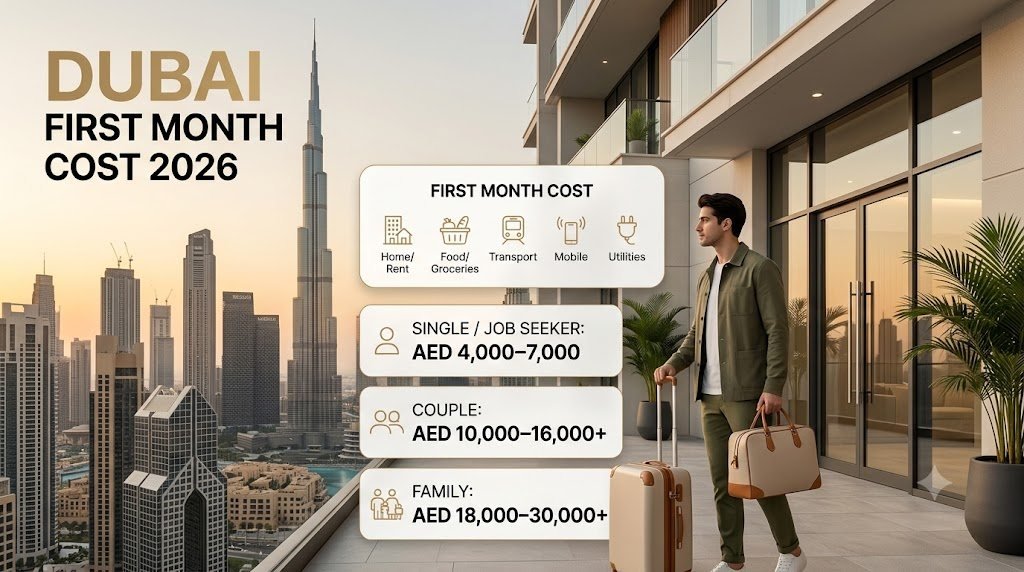
Dubai First Month Cost: Moving to Dubai is exciting, but the first month can cost considerably more than a normal monthly budget.
The reason is simple: a new resident may have to pay for accommodation, deposits, transport, groceries, a mobile connection, utilities and other setup expenses at almost the same time. For job seekers, visa and temporary accommodation costs can add even more.
So, how much money do you really need for your first month in Dubai?
For a single person living carefully in shared accommodation, AED 4,000–7,000 can be a practical starting budget. Someone renting a private studio may need AED 7,000–12,000 or more, while couples and families can require substantially more because of housing and upfront rental costs.
These are planning estimates, not government-set budgets. The actual amount depends mainly on where you live, whether you share accommodation, how you travel and whether your employer pays any costs.
Dubai First Month Cost
| Type of newcomer | Practical first-month budget |
|---|---|
| Job seeker in shared accommodation | AED 4,000–7,000 |
| Single person in a shared apartment | AED 4,500–7,500 |
| Single person renting a budget studio | AED 7,000–12,000+ |
| Couple | AED 10,000–16,000+ |
| Family of 3–4 | AED 18,000–30,000+ |
| Family renting a home with large upfront payments | AED 25,000–40,000+ |
The biggest difference between these figures is housing. Dubai's official investment guide says rental prices vary significantly according to location, property type, quality, age, layout and market conditions. It also recommends considering rent as a proportion of income rather than looking only at the advertised monthly equivalent.
The biggest expense: accommodation
If you are coming to Dubai without a large budget, shared accommodation is usually the easiest way to reduce your first-month expenses.
A job seeker may find shared rooms or bedspaces for considerably less than a private apartment, but these are market prices rather than government-set rates and vary by area and living arrangement.
For someone who wants their own apartment, the calculation changes dramatically.
Dubai's official real-estate guidance says tenants should account for:
-
Security deposit
-
DEWA security deposit
-
Dubai Municipality housing fee
-
Ejari registration
-
Possible chiller/air-conditioning charges
The government guide states that a typical rental security deposit can be 5%–10% of annual rent, while the DEWA deposit is AED 2,000 for an apartment and AED 4,000 for a villa. Dubai Municipality's housing fee is 5% of annual rent, collected over 12 months.
That means a person renting an apartment cannot simply calculate:
annual rent ÷ 12 = first-month housing cost.
The upfront cash requirement can be much higher.
DEWA deposit: AED 2,000 for an apartment
This is one of the most important first-month expenses for someone renting a private apartment.
DEWA officially lists a refundable security deposit of:
-
AED 2,000 for a residential flat
-
AED 4,000 for a residential villa
DEWA also lists a supply connection/activation charge. Its current move-in page shows AED 125 for connecting electricity and water through small meters, while its FAQ notes a total activation charge of AED 155 in the applicable service context. New tenants should therefore check the amount displayed during their actual DEWA move-in process rather than relying on an old third-party figure.
DEWA's move-in process is integrated with Ejari for eligible tenancy contracts, and the authority sends the tenant the account and security-deposit payment information after the Ejari process.
Ejari cost
Ejari registration is another small but necessary cost when renting a property.
Dubai Land Department currently lists:
AED 100 registration fee
AED 10 knowledge fee
AED 10 innovation fee
For online registration, the DLD page also lists a service-partner fee of AED 55 plus VAT, making the stated online total AED 177.75.
At Real Estate Services Trustee Centres, the listed total is AED 220.
This is why a newcomer should keep a little extra money available for rental paperwork rather than budgeting only for rent.
Dubai Municipality housing fee
Tenants also need to account for the Dubai Municipality housing fee.
The official Dubai investment guide states that it is 5% of annual rent, divided into 12 monthly payments.
For example:
AED 30,000 annual rent × 5% = AED 1,500 per year
That works out to:
AED 125 per month
For AED 40,000 annual rent:
AED 2,000 per year, or approximately AED 166.67 per month.
The housing fee is included in the DEWA billing system, with DEWA explaining that housing fees are divided into equal monthly instalments.
Check the rent before signing
Dubai's rental market changes from area to area, so there is no single “cheap Dubai rent.”
The Dubai Land Department's official Rental Index allows tenants to check rental information by property type, area, bedrooms and other details. The service is available through DLD's website and Dubai REST and other official channels.
This is a better starting point than relying on a generic article claiming that every studio or one-bedroom apartment costs the same.
Food: how cheap can you live in Dubai?
Food is one area where newcomers can control their expenses.
A person who cooks most meals at home can spend substantially less than someone eating at restaurants every day.
Current supermarket listings show that budget options are available.
For example, Carrefour currently lists several 5kg rice products around the low-AED-20s to AED 30 range, including Pharoes Egyptian Rice at AED 21.99 on promotion, Cleopatra Egyptian Rice at AED 25.79, Carrefour Premium Long Grain Rice at AED 25.99 and Priya Sona Masoori Rice at AED 29.29. Prices and promotions can change.
Carrefour currently lists:
-
Carrefour full-fat fresh milk, 2L: AED 9.99
-
Al Ain Farms eggs, 30: AED 23.29
-
Saha eggs, 30: AED 22.79
-
Fresh whole chicken, 1kg: AED 20.89
-
Al Arz Arabic bread, 540g: AED 3.49
-
Carrefour fresh yogurt, 1kg: AED 4.99 on promotion.
LuLu's current online prices also show budget choices, including:
-
LuLu full-cream milk, 2L: AED 10.50
-
Marmum full-cream milk, 2L: AED 12.40
-
Al-Fadeel white eggs, 30: AED 17.90
-
Marmum yogurt, 1kg: AED 6.95.
These prices demonstrate an important point: shopping strategically can make a significant difference to a newcomer's Dubai budget.
A realistic grocery budget
For one person who cooks regularly, a sensible planning range is:
AED 450–700 per month
For a person who mixes supermarket food with inexpensive restaurant meals:
AED 700–1,100
For a couple:
AED 1,000–1,600
For a family of four:
AED 1,600–2,500+
These are practical budgeting estimates rather than official government figures. Household size, diet, brands and promotions can change the final bill.
Eating out does not always mean spending AED 50
Dubai has many expensive restaurants, but inexpensive local restaurants and cafeterias can make a big difference for job seekers and workers on tight budgets.
Ravi's current official menu provides a good example.
Its menu lists:
-
Chicken biryani: AED 14
-
Vegetable biryani: AED 13
-
Dal fry: AED 8
-
Chicken kadhai: AED 14
-
Chicken tikka: AED 12
-
Omelette: AED 5
-
Tandoori roti: AED 1.50
-
Naan: AED 2.50
-
Chicken sandwich: AED 8
-
Chicken burger: AED 8
-
Veg burger: AED 7
-
Chicken kabab roll: AED 8
-
Fresh milk tea: AED 2
-
Karak/black/green tea: AED 1
-
Small mineral water: AED 2.
So a budget-conscious resident does not necessarily need AED 40–60 for every meal.
For example, a chicken biryani at AED 14 plus a small water at AED 2 would be AED 16 before any other items.
If someone spends an average of AED 15 on one inexpensive meal every day:
AED 15 × 30 = AED 450
Three such meals every day would be:
AED 1,350 per month
That is why cooking at home can make a major difference.
Dubai Metro and public transport costs
Public transport is another area where newcomers can keep expenses under control.
According to the RTA's current fare table, a Silver nol card journey costs:
-
AED 3 within one zone
-
AED 5 across two adjacent zones
-
AED 7.50 across more than two zones.
The current 30-day Silver travel passes are:
-
AED 140 — 1 zone
-
AED 230 — 2 zones
-
AED 350 — all zones.
For someone attending interviews across Dubai, the AED 230–350 range can therefore be a useful monthly transport planning figure.
Someone whose home and workplace are close together may spend considerably less.
Mobile and internet
A newcomer should also budget for communication.
A basic mobile plan can be planned at roughly AED 50–150 per month, depending on the operator, data allowance and promotion.
Home internet is a different matter. A private apartment may require a separate home broadband connection, while people living in shared accommodation may already have internet included in their rent.
Therefore, someone renting a bedspace should not automatically add a full home-internet bill to their personal budget.
Job seekers have a different first-month calculation
Someone arriving in Dubai to search for work should calculate their expenses differently from someone who already has an employment contract.
Dubai's GDRFA currently lists the employment-opportunity visit visa at:
-
AED 200 for 60 days
-
AED 300 for 90 days
-
AED 400 for 120 days
plus 5% VAT.
The authority also lists a AED 1,000 financial guarantee, a AED 20 warranty service fee and AED 40 for collection and return of the guarantee. Other charges can apply depending on the applicant's circumstances, including an additional inside-country fee where applicable.
Eligibility also matters. GDRFA states that applicants must meet requirements such as the relevant skill classification or qualifying recent graduation criteria, along with requirements including a degree, accommodation and proof of financial solvency.
So the visa cost should not simply be added to every new resident's budget.
Someone arriving with an employer-sponsored job is in a different situation. GDRFA's work-entry visa service linked to a job contract currently lists a AED 200 visa fee plus 5% VAT, with other charges potentially applying depending on circumstances.
What should a single job seeker actually budget?
Consider a person who chooses shared accommodation and uses public transport.
A realistic monthly survival budget could look like this:
| Expense | Budget |
|---|---|
| Shared accommodation | AED 800–1,500 |
| Groceries | AED 450–600 |
| Cheap meals outside | AED 200–400 |
| Public transport | AED 140–230 |
| Mobile | AED 50–100 |
| Laundry/personal items | AED 50–150 |
| Job-search miscellaneous costs | AED 100–250 |
| Estimated monthly spending | AED 1,790–3,230 |
This is a lean budget, not a comfortable lifestyle.
More importantly, a job seeker should have an emergency reserve because finding a job can take longer than expected.
For that reason, AED 5,000–7,000 in available cash/reserves is a much safer starting point for a single job seeker than arriving with only enough money for a few days, excluding the cost of flights and any visa or accommodation payments that have already been made.
What if you rent your own studio?
This is where the calculation changes.
Suppose a newcomer finds a budget studio with annual rent of AED 30,000.
The monthly rent equivalent is:
AED 2,500
But the first month can also involve:
-
Rental security deposit
-
Agency fee, if applicable
-
Ejari
-
DEWA apartment deposit: AED 2,000
-
DEWA activation
-
Housing fee
-
Food
-
Transport
-
Mobile/internet
-
Household items
The official Dubai real-estate guide says security deposits are generally 5%–10% of annual rent, while the DEWA apartment deposit is AED 2,000 and Ejari is around AED 220 in its general rental guidance. The current DLD service page gives the more specific online Ejari total of AED 177.75 and trustee-centre total of AED 220.
This is why AED 7,000–12,000+ is a more realistic first-month planning range for a single person taking a private budget studio, depending heavily on the rent payment structure and agency/deposit requirements.
Families need a much larger starting fund
Families face costs that a single newcomer can avoid.
The major expenses are:
-
Larger accommodation
-
Rental deposit
-
DEWA deposit
-
Utilities
-
Food
-
Transport
-
Dependent visas
-
Medical fitness requirements where applicable
-
Emirates ID/residency-related expenses
-
School or nursery expenses
-
Household setup
This is why a family should not use a single-person Dubai budget and simply multiply it by the number of family members.
A family of three or four should generally plan for AED 18,000–30,000+ for the first month, with the possibility of substantially higher costs if a large rental payment, school fees or major setup expenses fall due immediately.
The real answer: Dubai first month cost depends on your housing choice
For most newcomers, food is not what makes the first month expensive.
Housing and upfront payments do.
A person living in shared accommodation can keep food and transport relatively low. Someone renting an apartment independently can suddenly face thousands of dirhams in deposits and setup expenses before their normal monthly lifestyle even begins.
That is the biggest difference between Dubai monthly cost of living and Dubai first month cost.
A practical budget to remember
Job seeker: AED 5,000–7,000+
Single resident with shared accommodation: AED 4,500–7,500
Single resident with private studio: AED 7,000–12,000+
Couple: AED 10,000–16,000+
Family: AED 18,000–30,000+
Keep additional money aside for flights, visa expenses, major rental payments, medical costs, school fees and emergencies where applicable.
Before moving to Dubai, check these costs
Before leaving for Dubai, calculate your budget using these questions:
-
Will I share accommodation or rent alone?
-
How much is the security deposit?
-
How much rent must I pay upfront?
-
Do I have to pay an agency fee?
-
How much is my DEWA deposit?
-
How much will Ejari cost?
-
What will my monthly housing fee be?
-
Can I use Metro and buses instead of taxis?
-
Will I cook at home?
-
Is internet included in my accommodation?
-
Is my visa employer-sponsored or am I coming as a job seeker?
-
How much emergency money will remain after I arrive?
Dubai's official Rental Index is particularly useful before signing a tenancy contract because rental values vary substantially by area and property.
If you are moving to Dubai for the first time, do not plan your budget using rent + food alone.
For a single person on a tight budget, AED 4,000–7,000 can cover a lean first month when accommodation is shared. A private apartment can push the first-month requirement to AED 7,000–12,000 or more, mainly because of deposits and rental setup.
For couples and families, the required amount rises quickly.
The safest approach is to calculate monthly living expenses separately from one-time arrival costs and keep an emergency reserve. That gives you a much more realistic picture of how much money you actually need to move to Dubai in 2026.



0 comments
No comments yet. Be the first.