
Dubai Gold Facts: Dubai is famous for its Gold Souk, but its connection with gold goes far beyond rows of jewellery shops in Deira. The emirate has developed a major gold ecosystem covering jewellery, bullion, refining, trading, investment and precious-metal services.
Dubai currently accounts for around 15% of global gold trade, according to DMCC, making the emirate an important centre in the international gold market.
Here are some of the most interesting facts behind Dubai's reputation as the City of Gold.
Dubai's gold trade is much bigger than the Gold Souk
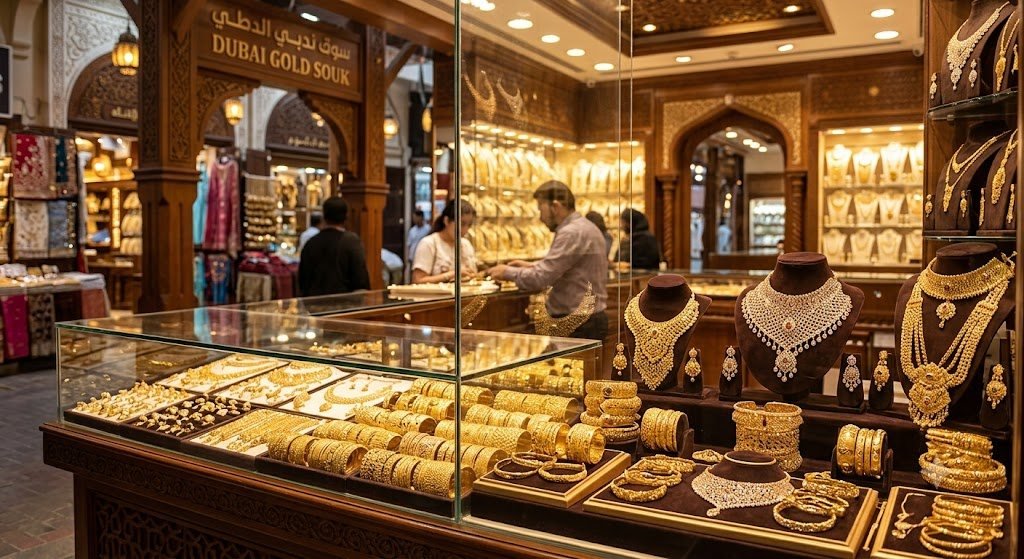
The Gold Souk is probably the most recognisable part of Dubai's gold industry, but it represents only the retail side of a much larger business.
Dubai's gold ecosystem includes bullion trading, refining, jewellery manufacturing, wholesale and retail, vaulting and investment. DMCC describes the emirate as a global hub covering different stages of the gold value chain.
This is why Dubai's gold industry cannot be measured simply by counting jewellery shops.
Dubai once handled 1,200 tonnes of gold in a year
One of the most striking historical figures comes from Dubai's development as a global gold centre.
DMCC records that around 1,200 tonnes of gold traded through Dubai in 2011. At the time, that represented roughly one-quarter of global gold demand. The value of Dubai's gold trade also grew dramatically, from about US$6 billion in 2003 to US$56 billion in 2011 and US$70 billion in 2012.
These figures show how quickly Dubai developed from a regional trading centre into an important international gold hub.
The Gold Souk grew from Dubai's trading history
Dubai's gold story is closely linked to Dubai Creek, which historically connected the emirate with merchants and trading routes.
The creek and harbour helped facilitate the movement of goods, including gold, through traditional dhow trade. Over time, the gold market around Deira developed into the famous Gold Souk.
Today, DMCC says the Gold Souk district has more than 400 retail and wholesale shops.
Dubai Gold Facts: Dubai has a gold market beyond physical jewellery
Gold in Dubai is not limited to physical purchases.
The emirate also has a financial trading infrastructure for commodities. The Dubai Gold and Commodities Exchange recorded 5.4 million contracts in 2023, with a reported value of approximately US$115.3 billion.
For many visitors, the Gold Souk is their introduction to Dubai's gold market. Behind it, however, is a much larger wholesale and financial ecosystem.
Gold prices can change during the same day
Dubai's gold price is not necessarily a single fixed number for the entire day.
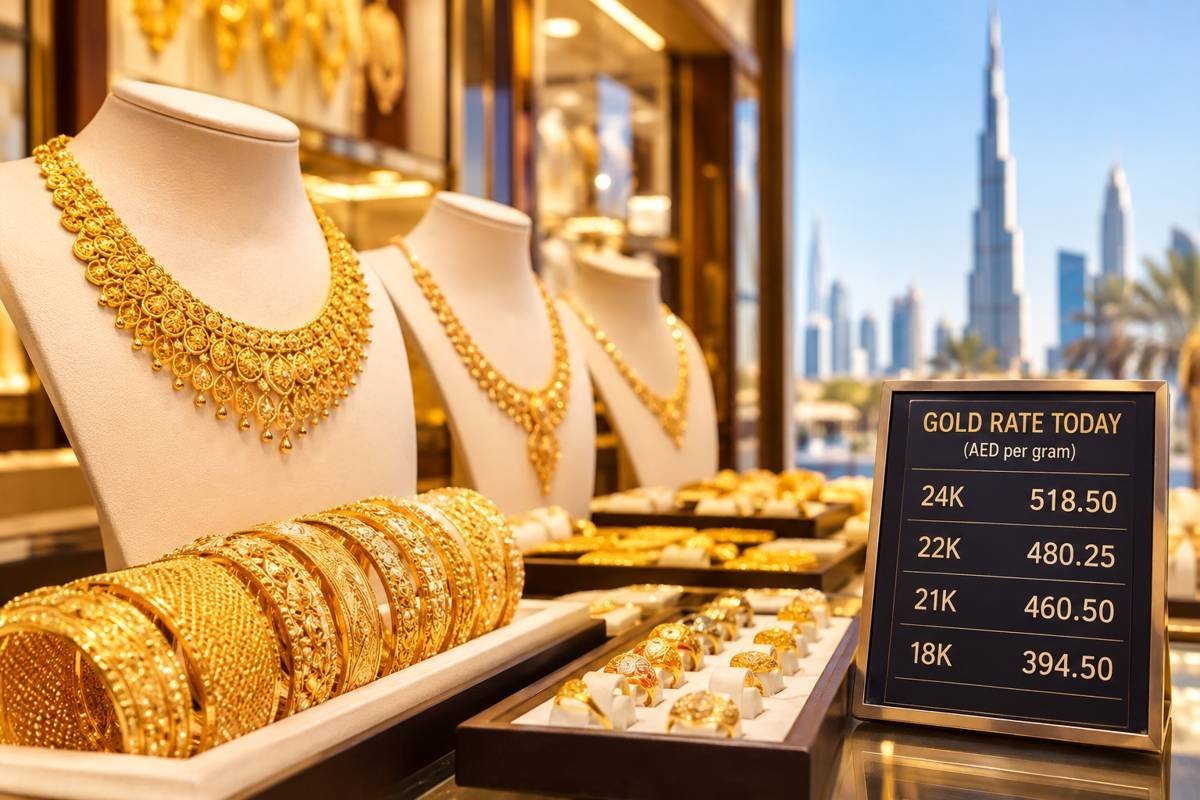
The Dubai Jewellery Group says its suggested retail gold rates are updated three times daily — at 9am, 3pm and 8pm UAE time.
This is particularly important for people planning to buy jewellery because the gold component of a purchase can change as the international market moves.
24K isn't the only gold sold in Dubai
Dubai's jewellery market offers different levels of gold purity.
24K represents the highest commonly traded purity and is widely associated with bars and coins. 22K is widely used for jewellery such as chains and bangles, while 18K is frequently used for diamond and stone-set jewellery.
Therefore, two pieces described simply as “gold jewellery” can contain significantly different proportions of pure gold.
The displayed gold rate isn't the final jewellery price
One of the biggest points buyers need to understand is that the daily gold rate does not necessarily equal the final price of a jewellery item.
The final bill can include the value of the gold, the labour or making charge, design-related costs and applicable VAT. Visit Dubai says the gold value generally accounts for around 80% to 90% of the final jewellery price.
This is why comparing only the advertised gold rate may not tell you which piece will have the lowest final price.
Buyers can request a digital authentication certificate
Dubai has also introduced digital tools to give jewellery buyers more information about their purchases.
Visit Dubai says dealers are obliged to provide a digital authentication certificate on request. It can contain information including the karat, actual gold weight, stone weight and labour cost.
For buyers, this can make it easier to understand what they are actually paying for.
Dubai gold is regulated
Another important fact is that the UAE's gold market operates within a formal regulatory framework.
Federal legislation covers the trade in precious stones and precious metals and their stamping. The UAE's legislation portal lists Federal Law No. 11 of 2015 as active legislation governing this area.
Dubai's reputation therefore comes not only from its large markets but also from the regulations governing precious-metal trading.
Dubai is working on responsible gold sourcing
Dubai's modern gold story also includes responsible sourcing.
UAE regulations require relevant businesses to carry out supply-chain due diligence for gold. The framework includes identifying and assessing supply-chain risks, responding to those risks, independent third-party review and reporting requirements for relevant refiners.
The rules are intended to address risks associated with gold coming from conflict-affected and high-risk areas.
Dubai has its own Good Delivery standard
The UAE has also developed the UAE Good Delivery standard for the gold sector.
DMCC describes the standard as supporting international best practices related to responsible sourcing, refining and distribution of gold and gold products.
This is another indication that Dubai's gold industry extends into refining and wholesale markets rather than being primarily a retail jewellery destination.
The Dubai Jewellery Group has hundreds of members
The Dubai Jewellery Group says it has more than 600 members across areas including bullion, manufacturing, wholesale, retail, precious metals, diamonds and pearls.
The organisation was established in 1996, reflecting the long-term development of Dubai's organised jewellery trade.
Dubai's jewellery market serves different cultures
Dubai's gold market has developed around an international customer base.
Jewellery sold in the emirate includes designs influenced by Arabic, Indian, Turkish and Italian traditions, alongside bridal, antique, polki and contemporary styles.
This diversity is one reason Dubai's jewellery market offers everything from traditional heavy gold pieces to lightweight modern designs.
High gold prices are changing what people buy
The recent gold-price environment has also affected jewellery demand in the UAE.
The World Gold Council reported that UAE jewellery demand fell from 34.7 tonnes in 2024 to 29.4 tonnes in 2025, a decline of about 15%. However, the value of jewellery demand increased because gold prices were significantly higher.
This creates an interesting situation: people can buy less gold by weight while spending more money on it.
Lightweight jewellery is gaining attention
As gold becomes more expensive, lightweight jewellery provides a way for buyers to purchase gold while reducing the amount of metal in each item.
Visit Dubai has highlighted demand for lighter pieces such as delicate chains and slimmer bracelets.
This trend is particularly relevant when gold prices are high because even a small difference in weight can affect the final bill.
Dubai gold isn't completely tax-free
Another common misconception is that buying gold in Dubai automatically means paying no tax.
The UAE applies 5% VAT. Eligible tourists can apply for a VAT refund when leaving the country, subject to the requirements of the UAE Federal Tax Authority.
The FTA currently states that eligible tourist purchases must meet a minimum transaction value of AED 250 excluding VAT, while the refund process has specific validation and refund conditions.
So tourists should look at the complete purchase price rather than assuming every gold purchase is automatically tax-free.
Dubai became known as the City of Gold
Dubai's nickname is not based on the Gold Souk alone.
Its reputation developed through a combination of historic trading routes, a large jewellery market, international gold flows, bullion and commodity trading, refining, regulation and a global customer base.
From the traditional shops of Deira to modern commodity markets, Dubai's gold industry now operates across almost the entire value chain.
That is what makes Dubai's gold story more than a shopping attraction — it is a major part of the emirate's international trading economy.
0 comments
No comments yet. Be the first.