

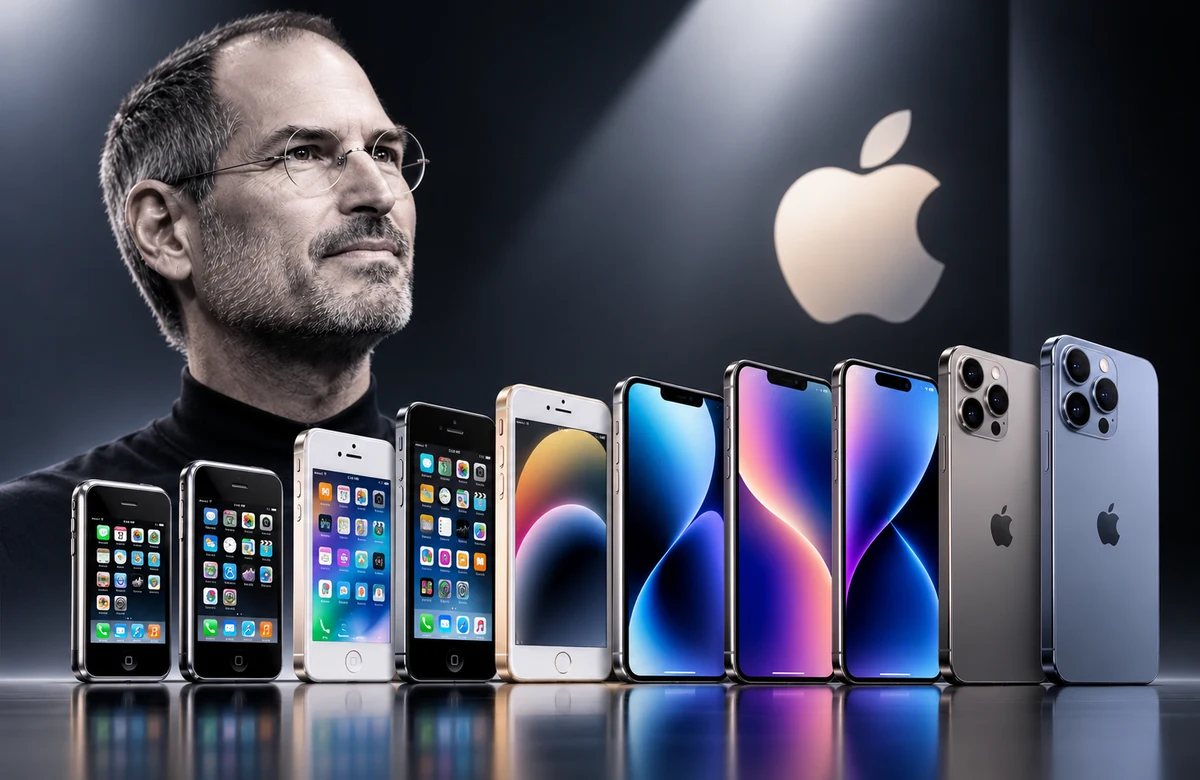
The Original iPhone Had No App Store: The iPhone Story Most People Don’t Know
When Steve Jobs introduced the first iPhone in January 2007, he presented it as three products in one: a mobile phone, a widescreen iPod and an internet communication device.
Today, the iPhone is known for its powerful cameras, advanced processors, premium design and millions of apps. But its earliest version was surprisingly limited compared with modern smartphones.
The original iPhone had no App Store, no front-facing camera and no 3G connectivity. Yet it became one of the most influential products in technology history.
Here are 20 fascinating facts that reveal how the iPhone evolved from an ambitious experiment into a global smartphone phenomenon.
1. The First iPhone Was Introduced Before It Went on Sale
Steve Jobs unveiled the original iPhone on January 9, 2007, at Macworld in San Francisco.
However, customers had to wait until June 29, 2007, to purchase it in the United States.
The gap between announcement and availability gave Apple time to prepare the product for its first major launch.
2. The Original iPhone Cost $499
The first iPhone was available in two storage versions:
-
4GB model: $499
-
8GB model: $599
These prices were for the original US launch and came with carrier requirements.
The 4GB version was discontinued relatively quickly, making it a particularly interesting part of the early iPhone story.
3. The First iPhone Had No App Store
This is one of the most surprising facts about the original iPhone.
Although the device introduced a new touchscreen experience, users could not download apps through an official App Store in 2007.
Apple introduced the App Store in July 2008, opening the door to third-party applications, games and services.
That decision helped transform the iPhone from a smartphone into a software platform.
4. Copy and Paste Was Missing From the Original iPhone
The first iPhone did not include copy-and-paste functionality.
Users had to wait for a later software update before they could copy text from one place and paste it into another.
It is a reminder that even a revolutionary product can launch without features people now consider essential.
5. The First iPhone Did Not Have a Selfie Camera
The original iPhone included a rear camera but no front-facing camera.
Front-camera photography and video calling became part of the iPhone experience with the iPhone 4 in 2010.
The early iPhone was designed primarily around phone calls, music, browsing and messaging rather than the selfie culture that later became popular.
6. The Original iPhone Used a 2G Network
The first iPhone supported EDGE mobile data rather than 3G.
This meant internet browsing could feel much slower than on later generations.
Apple addressed this limitation with the iPhone 3G in 2008, which introduced faster mobile connectivity and GPS support.
7. Steve Jobs Introduced the iPhone as Three Products in One
During the 2007 keynote, Jobs repeatedly described three separate products before revealing that they were actually one device.
The three ideas were:
-
A widescreen iPod with touch controls
-
A revolutionary mobile phone
-
An internet communication device
This presentation became one of the most memorable product launches in technology history.
8. The Original iPhone Sold One Million Units in Just 74 Days
Apple announced in September 2007 that it had sold its one-millionth iPhone.
The milestone came only 74 days after the phone went on sale.
For Apple, this was an important achievement because the company had taken almost two years to reach the same sales milestone with the iPod.
9. The First iPhone Was Built Under Extreme Pressure
Behind the polished launch presentation, Apple’s engineers faced serious technical challenges.
The original prototype was reportedly unstable, with problems involving software, hardware and everyday functionality.
A detailed account published by WIRED describes the difficult development period before the June 2007 release.
The final product looked simple to use, but creating that experience required a complicated engineering effort.
10. Apple Changed the Original iPhone’s Front Surface Before Launch
Shortly before the first iPhone went on sale, Apple announced a change to its front surface.
The company moved from a plastic surface to optical-quality glass.
The change was intended to improve durability and the overall display experience.
It also shows how closely Apple continued refining the product even near its launch date.
11. The iPhone 3G Made the App Store Possible
The iPhone 3G arrived in 2008 with faster connectivity and a new software ecosystem.
The App Store became one of the most important developments in the iPhone’s history.
Instead of relying only on built-in applications, users could install software for games, travel, communication, entertainment and productivity.
This helped create the modern smartphone app economy.
12. The iPhone 4 Introduced Retina Display
The iPhone 4, released in 2010, introduced Apple’s Retina Display branding.
Its high pixel density made text and images appear sharper than on earlier iPhone screens.
The model also introduced a major design change, combining glass and stainless steel.
It became one of the most recognisable iPhone generations.
13. Siri Arrived With the iPhone 4S
The iPhone 4S introduced Siri in 2011.
Users could ask questions and perform certain tasks through voice commands.
Siri was an early mainstream example of a voice-based digital assistant on a smartphone.
It helped establish the idea that interacting with a phone did not always require touching the screen.
14. Touch ID Changed How People Unlocked Their Phones
The iPhone 5s introduced Touch ID in 2013.
The fingerprint sensor was integrated into the Home button, allowing users to unlock their phones more conveniently.
Touch ID also became part of Apple’s authentication and payment experience.
It was an important step toward making biometric security a normal smartphone feature.
15. The iPhone 6 Introduced Larger Screens
Apple introduced the iPhone 6 and iPhone 6 Plus in 2014.
The iPhone 6 featured a 4.7-inch display, while the iPhone 6 Plus had a 5.5-inch screen.
The change reflected growing demand for larger smartphones.
It also showed that Apple was willing to move away from the compact screen sizes that had defined its earlier models.
16. The iPhone 7 Removed the Traditional Headphone Jack
The iPhone 7, released in 2016, did not include a standard 3.5mm headphone jack.
The decision generated considerable debate.
However, it also helped push the smartphone industry toward wireless audio and alternative connection methods.
The change became one of the most discussed design decisions in iPhone history.
17. The iPhone X Changed the Way Users Navigated Their Phones
The iPhone X arrived in 2017 to mark the iPhone’s tenth anniversary.
It introduced an edge-to-edge style display, Face ID and gesture-based navigation.
The familiar Home button disappeared.
This was more than a design update. It changed how users interacted with the device every day.
18. Apple Sold Its One-Billionth iPhone in 2016
In July 2016, Apple announced that it had sold its billionth iPhone.
This milestone demonstrated the scale of the product’s global success.
By January 2017, Apple reported that more than one billion iPhones had been sold over the product’s first decade.
The iPhone had become a major part of modern mobile computing.
19. The iPhone 12 Brought 5G and MagSafe
The iPhone 12 series introduced 5G connectivity across the lineup in 2020.
It also brought back a flat-edge design and introduced MagSafe for magnetic accessories and wireless charging.
These changes expanded the iPhone experience beyond the phone itself, strengthening its accessory ecosystem.
20. USB-C Marked the End of the Lightning Era
The iPhone 15 series adopted USB-C in 2023, replacing Apple’s Lightning connector.
This was a major connectivity change after more than a decade of Lightning-based iPhones.
USB-C made it easier to use compatible cables and accessories across a wider range of devices.
The Biggest Lesson From the iPhone’s Journey
The iPhone did not become successful because every feature was invented by Apple first.
Touchscreen phones existed before 2007. Digital cameras, mobile internet and voice assistants also had earlier versions.
Apple’s achievement was bringing many technologies together in a product that felt easier and more natural to use.
The original iPhone combined a phone, music player and internet device. The App Store later turned it into a platform. Successive generations improved the display, camera, security, connectivity and performance.
That is what makes the iPhone’s history so interesting: it is not simply a story of new models, but a story of how a device gradually changed the way people communicate, work, travel, photograph and access information.
From the first iPhone in 2007 to the modern smartphone era, Apple’s biggest achievement has been making complex technology feel simple.
Sources
-
Apple Newsroom — Original iPhone announcement, January 2007
-
Apple Newsroom — One millionth iPhone sold in 74 days
-
Apple Newsroom — iPhone at ten and the billion-unit milestone
-
WIRED — Inside Apple’s race to make the first iPhone
-
HISTORY — Steve Jobs debuts the iPhone
-
Apple Newsroom — iPhone model and feature announcements
Historical facts and launch milestones have been checked against Apple’s official records and established technology reporting. Exact search volumes and keyword competition are not claimed in this article.


0 comments
No comments yet. Be the first.