

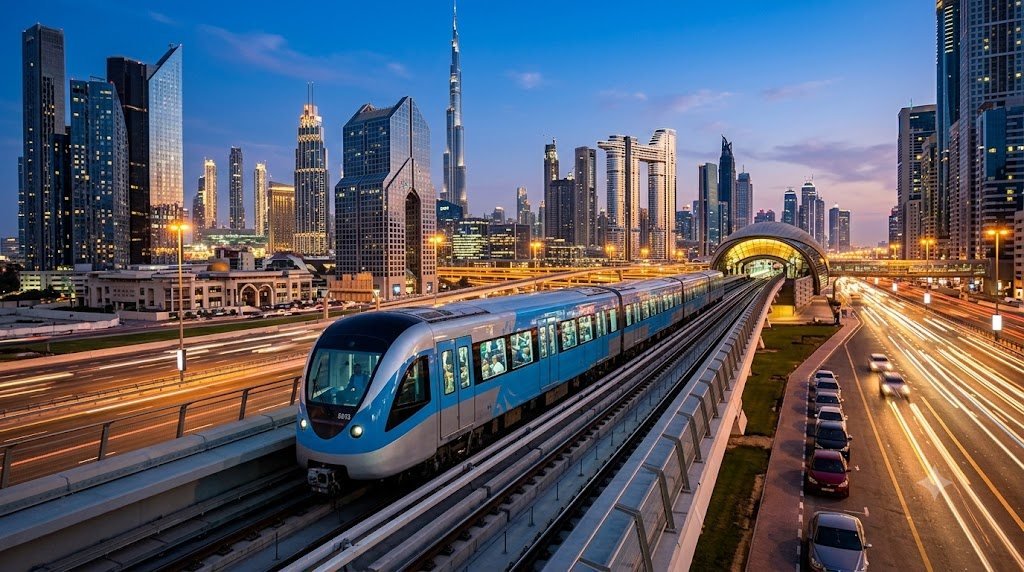
Dubai Metro Has No Drivers: The Metro operates without conventional train drivers, while a central control system monitors train movements, doors, brakes, communications, ventilation and other critical systems. At the same time, Dubai is increasingly using AI, robotics, energy-recovery technology and automated maintenance to keep the network moving.
For motorists, the Metro also plays an important role in Dubai's wider traffic system. Every passenger who uses the Metro for a journey instead of a private car represents one less vehicle journey on the road.
Dubai Metro has been driverless since 2009
Dubai Metro began passenger operations on September 9, 2009, with the Red Line. The Green Line opened in 2011.
The system was designed as a fully automated railway, meaning there is no conventional driver sitting at the front of the train controlling acceleration, braking and normal operations.
The famous opening itself was timed for 9:09:09 pm on 09/09/2009, giving the Metro one of the most unusual launch dates in Dubai's transport history.
RTA says the Metro has since carried nearly 2.8 billion passengers from its launch through the end of 2025. In 2025 alone, the Metro carried about 295 million passengers.
That scale matters for road traffic because the Metro provides a high-capacity alternative to private vehicles across some of Dubai's busiest corridors.
There is no driver, but the trains are constantly monitored
Calling Dubai Metro “driverless” does not mean that the trains operate without human supervision.
Dubai's Rail Operations Control Centre operates around the clock. It monitors train movements and automated train-operation systems as well as several other railway functions.
RTA says the control system monitors areas including:
-
Train movements
-
Automatic train operation
-
Communications
-
Electrical systems
-
Passenger information
-
Train starting and stopping
-
Brakes
-
Doors
-
Fire protection
-
Ventilation
-
Air conditioning
So instead of one driver controlling an individual train, Dubai Metro relies on automated systems supported by a centralised operational team.
What happens if something goes wrong?
This is one of the lesser-known parts of the Metro.
The trains and stations have emergency communication facilities, while the wider system includes CCTV, radio communications and links with emergency services.
RTA's Metro information says the network has more than 3,000 CCTV cameras across trains and stations. Emergency Call Boxes are also available in trains and stations.
These systems allow incidents to be identified and communicated to the people responsible for responding to them.
For passengers, this means “driverless” does not mean “unmonitored”.
Dubai Metro once held a driverless world record
There is an important distinction when discussing Dubai's driverless Metro.
The Red Line was recognised by Guinness World Records in 2011 as the longest driverless metro line, measuring 52.1 kilometres.
However, an older claim that Dubai has the world's longest driverless Metro network should not be used as a current fact. Guinness now lists Riyadh Metro's 176-kilometre driverless network as the world's longest driverless metro network.
Dubai's record therefore relates specifically to its Red Line and the record established in 2011.
The Metro is also becoming automated behind the scenes
The most interesting development isn't just the absence of a driver.
Dubai is increasingly using automation to maintain the railway itself.
RTA introduced ARIIS — Automated Rail Infrastructure Inspection System — an AI-powered robotic inspection system for Dubai Metro.
The system uses technologies including LiDAR, lasers and 3D cameras to inspect railway infrastructure.
RTA says the technology can reduce manual inspections by up to 70% and inspection time by approximately 75%.
That means the Metro is moving toward a system in which automation is involved not only in operating trains but also in checking the infrastructure on which those trains run.
Dubai Metro can recover energy when trains brake
Another technology hidden from passengers is the Metro's energy-recovery system.
When a train brakes, energy is produced. Dubai Metro uses HESOP technology to recover electrical energy generated during braking and feed it back into the network.
RTA has said the recovered energy can be used for systems such as station ventilation, lighting and lifts.
The technology was installed across both the existing Metro lines and Route 2020. RTA estimated significant annual electricity and carbon savings from the system.
In simple terms, some of the energy involved in slowing a Metro train does not simply disappear as heat. Part of it can be recovered and reused.
Some Metro depots generate solar power
Dubai Metro also has solar infrastructure.
Solar-panel installations have been developed at the Jebel Ali and Al Qusais Metro depots, as part of a wider RTA renewable-energy project that also includes the Al Safouh Tram Depot.
The planned combined capacity across the three sites is approximately 9.959 MW.
RTA says the panels are expected to have a lifespan of around 25 to 30 years.
This gives Dubai Metro another unusual characteristic: parts of the infrastructure supporting the rail system can generate renewable electricity.
Nearly 20,000 Metro lights have been replaced with LEDs
RTA has also been working on reducing electricity consumption inside Metro facilities.
A project replaced 19,968 lights with LED lighting during its first two phases.
RTA reported electricity savings of approximately 16.7 million kWh over two years and estimated energy-cost savings of around AED 7.6 million.
The project also reduced the reported carbon footprint by about 7,283 tonnes of CO₂.
For passengers, it may simply look like station lighting. Behind the scenes, however, thousands of individual lights form part of a large energy-management programme.
Dubai Metro trains are built for high passenger volumes
Dubai Metro is not designed like a conventional low-capacity urban train.
RTA says newer trains introduced for Route 2020 increased capacity from 643 to 696 passengers, an increase of about 8%.
The newer trains also received changes to seating layouts, handles, luggage areas, lighting and passenger-information displays.
That capacity becomes particularly important during peak periods when roads are carrying large numbers of vehicles.
Instead of hundreds of separate cars travelling along a road, a single Metro service can carry a large number of passengers along the same corridor.
The Metro runs alongside some of Dubai's busiest traffic corridors
The Red Line provides a rail connection along major parts of the Sheikh Zayed Road corridor.
This is significant from a traffic perspective because Sheikh Zayed Road is one of Dubai's most important road routes.
The Metro gives commuters an alternative to driving along the same broad urban corridor, particularly for people travelling between major business, residential and commercial areas.
The Green Line serves areas including Deira and Bur Dubai, connecting parts of older Dubai and providing another alternative to road-based travel.
Route 2020 added another major connection
Route 2020 extended Dubai Metro by 15 kilometres, including approximately 11.8 kilometres of elevated track and 3.2 kilometres underground.
The extension connected the Metro network with areas around Dubai South and Expo City Dubai.
The trains introduced for Route 2020 also received capacity and interior changes designed around the needs of passengers using the extended network.
Dubai Metro Has No Drivers: Dubai is now building the Blue Line
The next major expansion is the Dubai Metro Blue Line.
RTA says the project will cover approximately 30 kilometres, including 15.5 kilometres underground and 14.5 kilometres elevated.
The line is planned to have 14 stations and is scheduled to open on September 9, 2029.
It will connect major areas including Dubai Creek Harbour, Ras Al Khor, International City, Dubai Silicon Oasis, Dubai Academic City, Mirdif, Al Warqa and Dubai Festival City.
For traffic, this expansion is important because it will connect several areas that currently depend heavily on road transport.
A 1.3-kilometre Metro bridge is coming
One of the most unusual features of the Blue Line will be a 1.3-kilometre Metro bridge crossing Dubai Creek.
The project will combine elevated sections, tunnels and the major creek crossing as part of the new route.
RTA says the Blue Line is being designed to serve areas with a combined population expected to reach around one million people under Dubai's 2040 urban planning framework.
Dubai is planning a 74-metre-high Metro station
The Blue Line will also bring another unusual piece of Metro infrastructure.
RTA says the future Emaar Properties Station will rise approximately 74 metres, making it the world's highest Metro station once completed.
The station is planned to cover around 11,000 square metres and is expected to accommodate approximately 160,000 riders per day.
Another planned Blue Line station in International City is expected to become the network's largest underground interchange station, covering more than 44,000 square metres.
Even the tunnel construction is highly automated
Dubai's next Metro expansion involves enormous construction equipment.
RTA says a tunnel boring machine named Al Wugeisha is being used for the Blue Line.
The machine is approximately 163 metres long and weighs more than 2,000 tonnes.
It is designed to operate around the clock and is expected to excavate approximately 13 to 17 metres per day, depending on conditions.
That means the technology behind Dubai Metro extends well beyond the trains passengers see at stations.
Dubai Metro's tunnels require their own maintenance programme
The underground sections also require specialised maintenance.
RTA reported completing 51 specialised tunnel inspections during a major maintenance programme and resolving 873 corrective maintenance tasks.
The work included inspections, cleaning, rehabilitation and replacement of ageing components in Metro tunnel infrastructure.
This is an important point for understanding how a driverless railway remains reliable: automated trains still depend on thousands of physical components that need regular inspection and maintenance.
The Metro's punctuality is closely monitored
RTA reported a 99.7% punctuality rate in its 15-year Metro anniversary information.
That figure is an RTA-reported operational measure, rather than a claim that every individual passenger will experience a train arriving exactly on schedule.
Still, it illustrates the level of operational monitoring required for a railway carrying hundreds of millions of passengers each year.
Why this matters for Dubai road traffic
Dubai Metro is more than a tourist attraction or an alternative way to travel around the city.
It is part of Dubai's strategy for moving large numbers of people without requiring every journey to be made by private car.
The numbers show the scale. The Metro carried approximately 295 million passengers in 2025, while the network has carried nearly 2.8 billion passengers since opening.
At the same time, Dubai is expanding the network through the Blue Line and adding automated technologies for inspection, energy management and maintenance.
For drivers, that means Dubai's rail network is becoming increasingly important to the city's overall traffic system. The Metro gives commuters another option for travelling through major urban corridors, while its automation allows trains and infrastructure to be monitored and maintained through increasingly sophisticated technology.
The bigger story behind Dubai Metro
The most interesting fact about Dubai Metro is therefore not simply that there is no driver sitting inside the train.
The network has developed into a highly automated transport system involving:
-
Driverless train operation
-
A 24-hour operations control centre
-
AI-powered infrastructure inspection
-
Automated railway monitoring
-
Energy recovery from braking
-
Solar power at selected depots
-
Large-scale LED energy-efficiency projects
-
Automated safety and passenger-monitoring systems
-
Specialised tunnel maintenance
-
Robotic and machine-based infrastructure inspection
-
New automated Metro infrastructure under the Blue Line
Dubai started operating its driverless Metro in 2009. More than 17 years later, the city is continuing to push automation beyond the driver's cabin and into maintenance, energy management, infrastructure inspection and future rail construction.

0 comments
No comments yet. Be the first.