

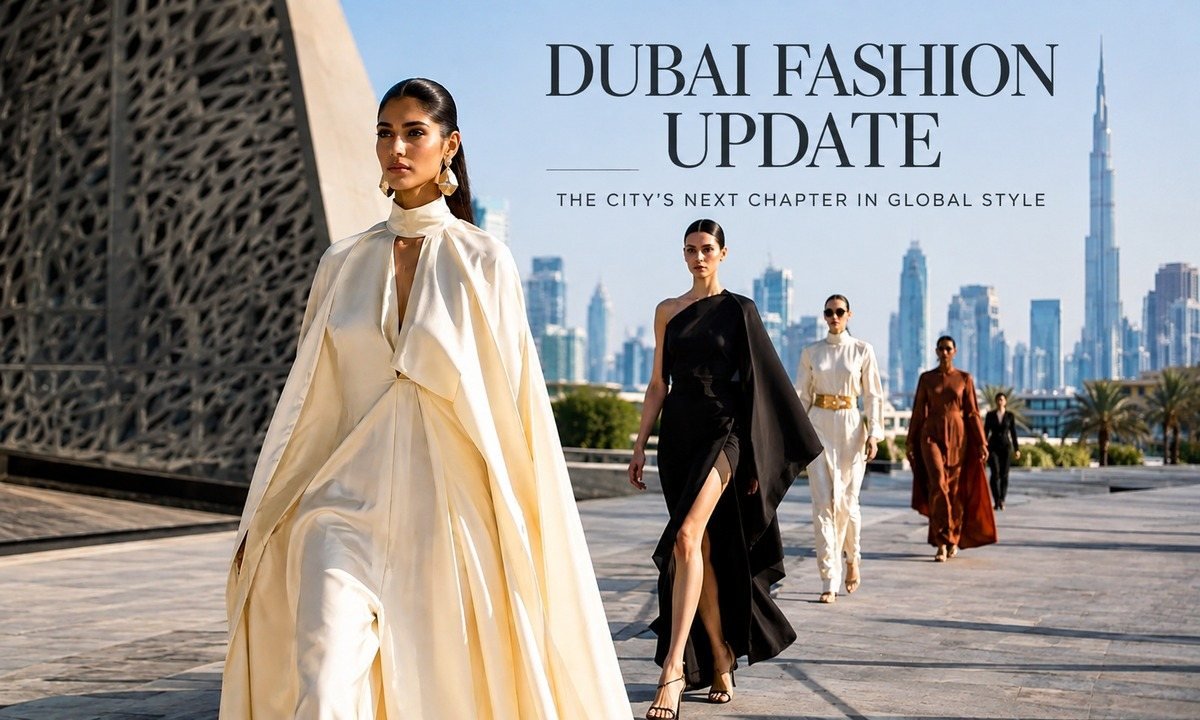
Dubai Fashion Enters a More Confident Chapter: There is a noticeable shift taking place in Dubai’s fashion landscape. The city’s relationship with fashion is becoming less about presenting luxury to the world and more about defining what contemporary fashion from the region can look like on its own terms.
Dubai Fashion Week 2026: That change will be particularly visible this autumn, when Dubai Fashion Week returns to Dubai Design District from 22 to 26 October for its Spring/Summer 2027 edition. The timing places the event closer to the international fashion and buying calendar, while giving regional designers another opportunity to engage with buyers, media and audiences beyond the Middle East.
What makes Dubai interesting at the moment is the mix of influences surrounding its fashion industry. Arab design traditions, South Asian craftsmanship and Western luxury codes increasingly meet within the same creative ecosystem. Rather than treating those influences as separate categories, designers in the region are finding ways to reinterpret them through contemporary tailoring, eveningwear, modest fashion and increasingly experimental silhouettes.
The evolution of Dubai Fashion Week itself reflects that ambition. Established in 2023 through a partnership between the Arab Fashion Council and Dubai Design District, the platform has developed beyond a conventional runway schedule. Its calendar has featured international names including Iris van Herpen, Jean Paul Gaultier, Roberto Cavalli, Moschino and Manish Malhotra, alongside designers from the region.
The February 2026 edition offered a useful indication of where that conversation is heading. Indian designer Manish Malhotra closed the season with INAYA: The India Story, a collection built around heritage and its contemporary interpretation. The choice was significant for a city whose fashion audience increasingly spans the Gulf, India and international luxury markets.
For the upcoming season, the larger story may therefore be less about individual trends and more about confidence. International fashion is already moving toward stronger personal expression, richer styling and a rejection of overly prescriptive ideas about what is considered “on trend.” Dubai’s fashion scene fits naturally into that movement, particularly because its designers operate at the intersection of multiple cultures and aesthetics.
There is also a growing commercial dimension to the conversation. The leadership of the Arab Fashion Council has described the next phase of Dubai Fashion Week as an ecosystem designed to provide designers with greater visibility, business access and opportunities for international growth. That approach could prove increasingly important as regional labels look beyond runway recognition toward sustainable global businesses.
The result is a fashion identity that feels increasingly self-assured. Dubai does not need to imitate Paris, Milan, London or New York to establish its relevance. Its advantage lies elsewhere—in its geography, its multicultural audience, its appetite for design and its ability to bring different fashion markets into the same conversation.
As the SS27 season approaches, Dubai appears to be entering a more mature stage of its fashion story: less concerned with proving that it belongs on the global fashion map, and more interested in deciding what it wants to contribute to it.



0 comments
No comments yet. Be the first.