
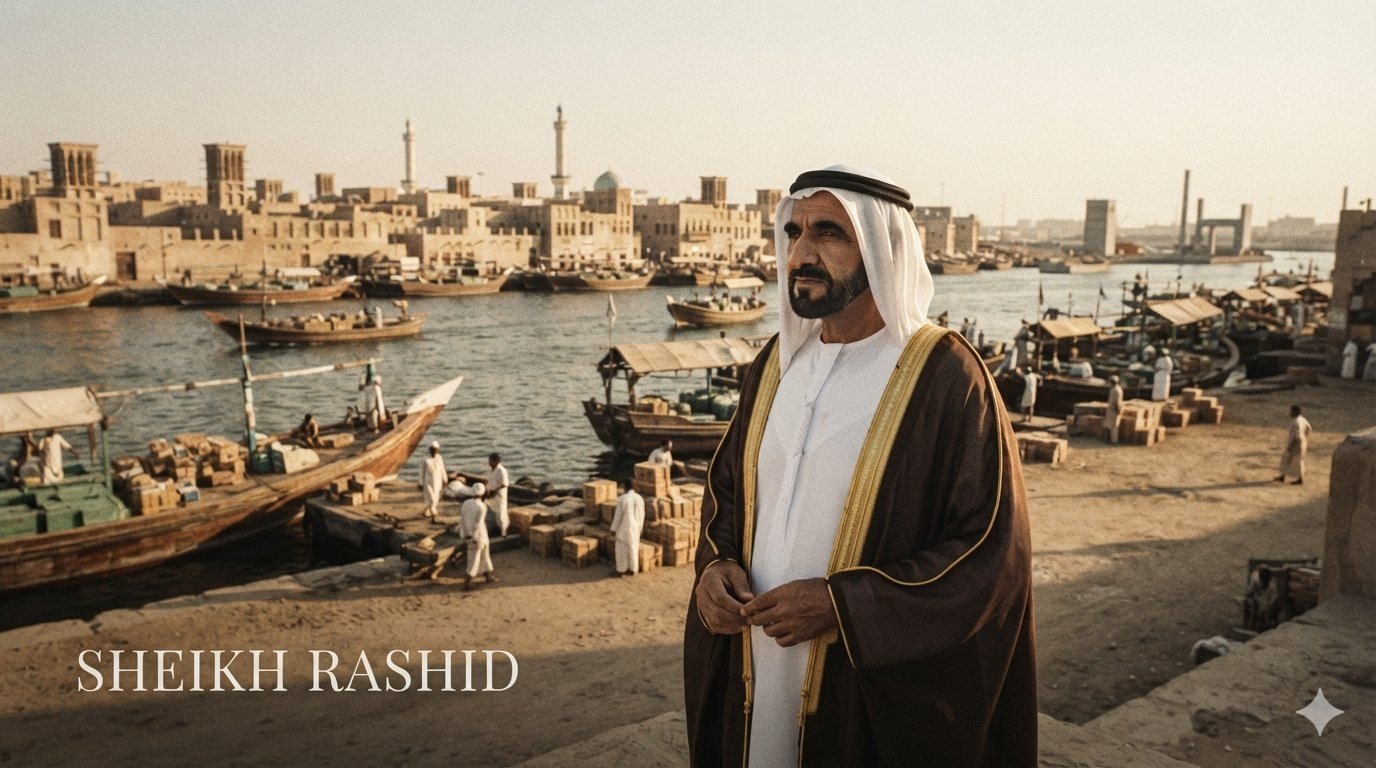
Sheikh Rashid Dubai Development History:Much of that early transformation happened under Sheikh Rashid bin Saeed Al Maktoum, who ruled Dubai from 1958 to 1990. His development strategy helped lay the foundations for the Dubai that emerged in the following decades.
So, what did Sheikh Rashid do for Dubai, and how did a small Gulf trading centre begin its journey towards becoming a global city?
Sheikh Rashid's Vision for Dubai Started With Trade
When Sheikh Rashid became ruler in 1958, Dubai Creek was already the centre of the emirate's commercial life. Traders and merchants depended on the Creek, but its shallow waters restricted the movement of larger ships.
Improving the Creek therefore became a priority.
The waterway was dredged during the late 1950s, making navigation easier and strengthening Dubai's position as a trading port. The project was an important early step because it addressed the basic requirement of any growing commercial centre: making it easier for goods and ships to enter and leave.
It was also a sign of Sheikh Rashid's broader approach to development.
Rather than waiting for Dubai to become wealthy before building major infrastructure, the emirate invested in infrastructure that could create future economic growth.
That philosophy would appear repeatedly during his rule.
Dubai Built an Airport Before It Became a Global Destination
One of the clearest examples was aviation.
Construction of Dubai's first airport began in 1959, and Dubai International Airport officially opened on 30 September 1960. At the time, the airport was modest, with a compacted-sand runway and a small terminal compared with the enormous airport Dubai has today.
But its importance went far beyond its size.
The airport gave Dubai a direct connection to international aviation at a time when the emirate was still developing its commercial identity.
Today, Dubai International is one of the world's best-known aviation hubs. But that global role has roots in the decision made during Sheikh Rashid's era to create an airport when Dubai was still relatively small.
Sheikh Rashid Dubai Development History: Roads and Bridges Connected a Growing Dubai
Infrastructure on the ground was just as important.
Dubai Creek separated the historic areas of Deira and Bur Dubai, making transportation between the two sides dependent largely on boats.
The opening of Al Maktoum Bridge in 1963 provided a permanent road connection across the Creek. It helped people and goods move more efficiently between the two sides of the city.
At the same time, Dubai expanded its road network and public infrastructure.
These projects may appear ordinary compared with today's mega-developments, but they solved a fundamental problem: how to connect a city that was beginning to grow faster.
Dubai Municipality also developed its planning and public-service role during this period, helping the city move towards a more organised urban structure.
Port Rashid Took Dubai Beyond the Creek
As trade increased, Dubai needed more maritime capacity.
That led to Port Rashid, which opened in 1972.
The port gave Dubai a modern commercial shipping facility and helped the emirate expand its international trading activity beyond the traditional Creek.
But Sheikh Rashid was already looking further into the future.
The next port would be far larger.
Jebel Ali Was Built for a Dubai That Did Not Yet Exist
The development of Jebel Ali became one of the defining decisions of Sheikh Rashid's era.
Plans for the massive new port were approved in 1976, and Jebel Ali Port was inaugurated in 1979.
The scale of the project reflected a different way of thinking about Dubai's future. The objective was not simply to solve an immediate shortage of port capacity. It was to create an infrastructure base capable of supporting much larger volumes of international trade.
That decision eventually proved important to Dubai's rise as a logistics and commercial centre.
The Jebel Ali Free Zone, established in 1985, added another layer to the model by attracting companies and industrial activity close to the port.
Together, the port and free zone helped create a powerful combination:
shipping + logistics + business + international trade.
This became one of the foundations of Dubai's later economic diversification.
Dubai's Growth Was Never About Oil Alone
Oil is an important part of Dubai's history. The emirate began exporting oil in 1969, providing additional revenue for development.
But the idea that oil alone created modern Dubai misses a major part of the story.
During Sheikh Rashid's rule, Dubai was simultaneously developing its ports, airport, roads, utilities, government institutions and commercial infrastructure.
The goal was to make Dubai useful as a place to trade and do business.
That distinction matters because Dubai's economy later became known for sectors including logistics, aviation, tourism, real estate, finance and international commerce rather than depending solely on oil.
The infrastructure-first approach created the conditions for that diversification.
Sheikh Rashid's Dubai Was Also Part of the UAE's Story
Sheikh Rashid's role extended beyond the development of Dubai.
He worked with Sheikh Zayed bin Sultan Al Nahyan during the discussions that eventually led to the formation of the United Arab Emirates. Their 1968 agreement on closer cooperation was an important step towards federation.
The UAE was formed on 2 December 1971, with Sheikh Rashid becoming the country's Vice-President. He later became UAE Prime Minister in 1979.
For Dubai, the creation of the UAE also opened a new chapter in its development within a larger federation.
The Projects That Changed Dubai
The simplest way to understand Sheikh Rashid's development strategy is to look at what he chose to build.
| Project | Why it mattered |
|---|---|
| Dubai Creek dredging | Strengthened maritime trade |
| Dubai Airport | Connected Dubai with international aviation |
| Al Maktoum Bridge | Improved movement across the Creek |
| Port Rashid | Expanded commercial shipping |
| Jebel Ali Port | Created large-scale trade and logistics capacity |
| Jebel Ali Free Zone | Attracted international businesses |
| Roads and utilities | Supported population and economic growth |
These were not the landmarks that later made Dubai famous on postcards.
They were the infrastructure underneath the transformation.
Dubai Before the Skyscrapers
The most interesting part of Dubai's development history is that its transformation began when there were very few signs of the city the world knows today.
There was no Burj Khalifa.
There was no Palm Jumeirah.
There was no Dubai Marina skyline.
Instead, the priorities were much more basic: water, roads, ports, aviation, trade and connectivity.
Sheikh Rashid's contribution was to develop those foundations early enough for later generations to build on them.
By the time he died in 1990, Dubai had already changed dramatically from the trading centre he inherited in 1958.
The spectacular transformation that followed in the 1990s and 2000s had many contributors and many new policies. But much of the basic infrastructure and economic thinking that made that acceleration possible had been established during Sheikh Rashid's rule.
That is why the history of Sheikh Rashid and Dubai development is not simply the story of one ruler or a list of construction projects.
It is the story of how Dubai began building for a future that had not yet arrived.
Before Dubai built the world's tallest skyscraper, it built the roads, ports, airport and trading connections that made a global city possible.
0 comments
No comments yet. Be the first.