

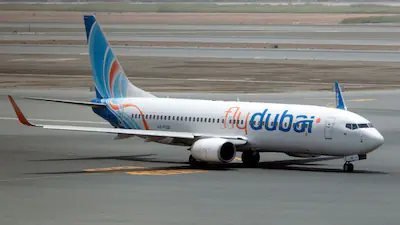
Flydubai Hijack Scare: A Flydubai flight travelling from Dubai to Tel Aviv was diverted to Saudi Arabia after a serious in-flight incident triggered an emergency response and briefly raised fears of a possible hijacking.
Flight FZ1073, operated by a Boeing 737 MAX 8, was flying toward Israel on September 30 when its flight-tracking data showed a series of unusual altitude changes. The aircraft subsequently transmitted the international 7500 transponder code, a signal associated with unlawful interference or a suspected hijacking.
The aircraft did not continue to Tel Aviv. Instead, it diverted to Tabuk in northwestern Saudi Arabia and landed safely.
Flydubai Hijack Scare: What happened to Flydubai Flight FZ1073?
According to flight-tracking information, FZ1073 departed Dubai International Airport and climbed to cruising altitude before experiencing an unusual sequence of altitude changes.
The aircraft first transmitted 7700, the international code used to indicate a general emergency. It later transmitted 7500, which is used when an aircraft is experiencing unlawful interference.
The 7500 signal immediately raised concerns because the aircraft was carrying passengers to Tel Aviv.
The flight subsequently changed course and headed toward Saudi Arabia, eventually landing at Tabuk.
Flydubai later confirmed that the aircraft had experienced an incident during the flight and said that all passengers and crew were safe and accounted for.
Was the Flydubai plane hijacked?
At this stage, describing the incident simply as a hijacking would be misleading.
The 7500 signal explains why authorities initially treated the situation as a potential hijacking. Israeli authorities reportedly scrambled fighter aircraft and began an emergency security response.
However, Israeli officials later said the incident was not believed to have been a conventional hijacking.
Instead, reports indicate that a confrontation occurred involving members of the flight crew.
That distinction is important because several more dramatic claims circulating online have not yet been independently established.
Reports of a fight inside the cockpit
Reuters and other major news organizations have reported that Israeli officials believed there had been a physical confrontation involving the pilots.
Israeli media have published more detailed allegations, including claims that a knife may have been involved and that one pilot may have attacked another.
Some reports have also suggested that the struggle could have contributed to the aircraft's dramatic descent.
However, Flydubai has not publicly confirmed all of those details.
The airline's public statement has remained comparatively limited, confirming the in-flight incident, the diversion to Tabuk and the safety of those aboard.
Why did the aircraft suddenly lose altitude?
One of the most striking elements of the incident was the aircraft's rapid change in altitude.
Flight-tracking data indicates that FZ1073 experienced an exceptionally steep descent while the emergency situation was developing.
The aircraft then recovered altitude before continuing toward Saudi Arabia.
The data establishes that the unusual descent happened. It does not, by itself, establish why it happened.
Investigators would need access to information such as the aircraft's flight-data recorder, cockpit voice recorder, control inputs and physical evidence before determining whether the descent was caused by a struggle, an intentional action, a technical problem or another factor.
Why did Israel scramble fighter jets?
The combination of circumstances required authorities to treat the situation seriously.
The aircraft was:
-
carrying passengers toward Israel;
-
transmitting an emergency code;
-
later transmitting the 7500 unlawful-interference code;
-
showing unusual flight behaviour; and
-
approaching a region with heightened security concerns.
Israeli authorities therefore reportedly scrambled fighter aircraft while officials assessed what was happening.
The response does not necessarily mean authorities concluded that a terrorist attack was taking place. In aviation security, a 7500 signal is treated as a serious warning requiring an immediate response.
Why did the plane land in Saudi Arabia?
Rather than continuing toward Tel Aviv, the aircraft diverted to Tabuk in Saudi Arabia.
The diversion provided a safe landing location while the incident was dealt with.
The destination was particularly notable because the passengers were travelling to Israel and Saudi Arabia does not have formal diplomatic relations with Israel.
Despite the unusual circumstances, the aircraft landed safely and passengers were reported to be accounted for.
What happened to the passengers?
Flydubai said that all passengers and crew were safe and accounted for following the landing.
Reports indicate that arrangements were being made to get the passengers onward to Israel, including the possibility of another aircraft operating the journey.
The immediate priority after the landing was therefore passenger safety and the investigation into what had happened aboard FZ1073.
What is confirmed — and what is still unclear?
There are several facts that can currently be established with reasonable confidence.
Confirmed:
-
Flydubai Flight FZ1073 was travelling from Dubai to Tel Aviv.
-
The aircraft experienced a serious in-flight incident.
-
It transmitted emergency signals, including 7700 and 7500.
-
The aircraft underwent an unusual rapid descent.
-
It diverted to Tabuk, Saudi Arabia.
-
The aircraft landed safely.
-
Flydubai said passengers and crew were safe and accounted for.
-
Israeli authorities initially responded to the 7500 signal as a potential security threat.
Still being investigated or reported without full independent confirmation:
-
The exact nature of the confrontation in the cockpit.
-
Whether a knife was used.
-
Which individual initiated the confrontation.
-
Whether either pilot deliberately attempted to force the aircraft into a dangerous descent.
-
The motive behind the incident.
-
Whether the event should be legally classified as an attempted hijacking.
Why the 7500 signal matters
The 7500 transponder code is one of the most recognizable emergency signals in aviation.
Unlike 7700, which generally indicates an emergency, 7500 specifically indicates unlawful interference.
That does not necessarily mean that an aircraft has been successfully hijacked. It tells air-traffic authorities that the crew is indicating a serious security problem.
In the case of FZ1073, the signal appears to have been particularly significant because it occurred alongside unusual aircraft movements.
What happens next?
The investigation will be crucial in determining what actually happened inside the aircraft.
Investigators are likely to examine the aircraft's flight-data recorder and cockpit voice recorder, interview crew and passengers, inspect the aircraft and reconstruct the sequence of events using air-traffic-control and flight-tracking information.
Those findings should help answer the biggest unanswered questions: why the 7500 code was transmitted, what caused the rapid descent and what happened between the pilots.
For now, the safest description is that Flydubai FZ1073 experienced a serious cockpit-related incident that triggered a hijack alert before the aircraft diverted safely to Saudi Arabia.
The more dramatic claims surrounding an alleged stabbing or deliberate attempt to crash the aircraft should be treated as allegations until investigators or the airline officially confirm them.
The Flydubai FZ1073 incident began as a frightening aviation emergency after the aircraft transmitted a hijack-related 7500 signal and experienced a dramatic change in altitude.
The plane ultimately landed safely in Tabuk, and Flydubai confirmed that everyone aboard was safe.
While reports increasingly point to a confrontation involving the pilots, important details remain under investigation. Until authorities release further findings, it is important to distinguish between the confirmed emergency, the reported cockpit altercation and unverified claims about an intentional attempt to bring down the aircraft.



0 comments
No comments yet. Be the first.