

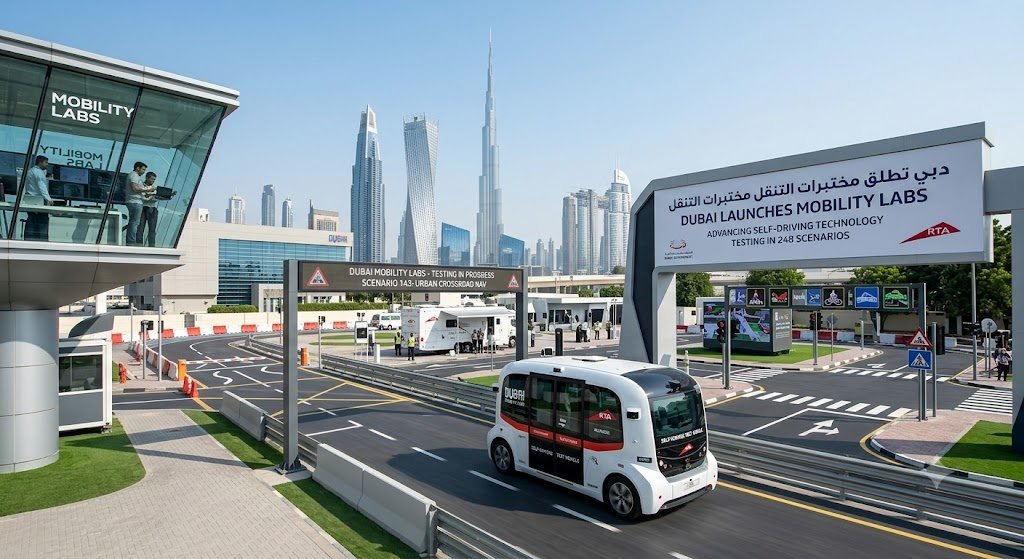
Dubai Launches Mobility Labs: Dubai has opened a new testing facility for autonomous vehicles, with 248 testing scenarios designed to help self-driving and future mobility technologies move from controlled trials towards real-world use.
Dubai's Roads and Transport Authority (RTA), in partnership with the Dubai Integrated Economic Zones Authority (DIEZ), has inaugurated Dubai Mobility Labs in Dubai Silicon Oasis.
The facility brings together controlled testing areas and public-road trials, giving developers a place to test how autonomous vehicles respond to different traffic and environmental conditions before technologies progress towards wider deployment.
The launch comes as Dubai works towards its target of making 25% of all mobility journeys autonomous by 2030.
Dubai Mobility Labs location and purpose
Dubai Mobility Labs is located in Dubai Silicon Oasis, within the specialised economic zone operated by DIEZ.
The facility is designed for companies, technology developers and other organisations working on autonomous and future mobility systems.
Unlike a testing site limited to a closed track, the Dubai Mobility Labs combines a controlled environment with real-world testing on public roads extending from Dubai Silicon Oasis towards Al Qudra.
This allows autonomous vehicles to be assessed in different conditions and gives developers a pathway from initial testing to public-road trials and, eventually, commercial deployment.
Dubai Launches Mobility Labs: 248 testing scenarios
The number 248 refers to the testing scenarios available across the wider Dubai Mobility Labs ecosystem.
The multi-purpose controlled testing area itself contains 195 scenarios.
Of those, 143 were included in the core design, while another 52 scenarios were added through design enhancements.
The scenarios are designed to test how autonomous vehicles sense their surroundings, make decisions and respond to changing situations involving traffic and other road users.
The wider testing programme also includes public-road trials, taking the total ecosystem to 248 scenarios.
This is important because the 248 figure should not be interpreted as 248 separate tracks. It represents the range of testing scenarios available across the controlled and real-world testing environment.
How self-driving vehicles will be tested
Autonomous vehicles need to deal with far more than simply following a marked road.
The Dubai facility is designed to assess systems that detect their surroundings, make driving decisions and respond when road conditions change.
Testing can examine how vehicles interact with other road users and how their systems respond to different traffic and environmental conditions.
The controlled environment allows developers to test these situations before vehicles move to public-road trials. This creates a structured process for checking technology, validating performance and assessing readiness.
Tesla, WeRide and Pony.ai have already tested technology
Dubai Mobility Labs is already being used.
RTA said the facility has hosted trials involving autonomous-driving technologies and vehicles developed by WeRide, Pony.ai and Tesla.
Their involvement shows that the facility is intended for actual technology testing rather than being only a future development project.
The presence of different technology developers also gives the facility a role in testing various approaches to autonomous mobility rather than being tied to one vehicle or technology platform.
Public-road testing is part of the facility
One of the notable features of Dubai Mobility Labs is the connection between controlled testing and public-road trials.
Testing routes extend from Dubai Silicon Oasis towards Al Qudra.
This allows developers to move beyond simulated or controlled situations and examine how autonomous systems perform in real road environments.
RTA says combining controlled testing with operational trials on public roads can improve the reliability of test results and help speed up development and certification.
Three 60 kW EV chargers are included
The facility is also equipped for electric mobility testing.
RTA says Dubai Mobility Labs includes three electric-vehicle chargers rated at 60 kW each, along with three light-industrial units for operational and indoor activities.
The site also has office and support facilities for organisations taking part in testing.
DEKRA will operate the facility for three years
RTA has appointed DEKRA to operate Dubai Mobility Labs during its first three years.
Its responsibilities include managing day-to-day operations, organising testing activities, overseeing the facilities and ensuring compliance with international safety standards and operational practices.
This gives the testing programme an independent operational framework as companies assess their autonomous mobility technologies.
Dubai's 2030 self-driving target
The new facility is directly connected to Dubai's Smart Self-Driving Transport Strategy.
The strategy aims to make 25% of all mobility journeys in Dubai autonomous by 2030.
The target refers to mobility journeys, rather than saying that 25% of vehicles on Dubai's roads will be driverless.
Dubai Mobility Labs is intended to support the testing and certification needed to move more autonomous technologies towards real-world operation.
Does this mean driverless cars can now operate everywhere in Dubai?
No.
The opening of Dubai Mobility Labs is the launch of a testing and certification environment. It does not represent blanket approval for autonomous vehicles to operate throughout Dubai.
Vehicles and technologies still need to go through the relevant testing, validation and regulatory processes before wider deployment.
Current autonomous passenger services also operate under specific arrangements and locations; the new facility provides additional infrastructure for testing future systems.
Why Dubai Mobility Labs matters for drivers
For ordinary motorists, the immediate effect is not a new road rule or a requirement to change how they drive.
The significance is longer term.
Autonomous vehicles must be able to recognise traffic, respond to other road users and deal with changing road conditions before they can safely operate at a larger scale.
By providing controlled testing and public-road trials in the same ecosystem, Dubai is creating infrastructure for that development process.
The facility could therefore become an important part of how new autonomous vehicles and mobility technologies are tested before reaching more Dubai roads.
The new labs give technology developers a route to continue testing autonomous systems under controlled and real-world conditions.
RTA's stated objective is to support the complete process from development and testing to validation, certification and eventual deployment.
For Dubai residents, the development is particularly relevant because the emirate's 2030 strategy targets a significant share of mobility journeys becoming autonomous.
As testing expands, future developments could involve more autonomous vehicles, additional technology companies and further public-road trials.
Dubai Mobility Labs: key facts
Location: Dubai Silicon Oasis
Opened: September 27, 2026
Testing scenarios: 248 across the wider ecosystem
Controlled-area scenarios: 195
Core controlled scenarios: 143
Additional scenarios: 52
Public-road route: Dubai Silicon Oasis towards Al Qudra
EV chargers: 3 × 60 kW
Companies already involved in trials: WeRide, Pony.ai and Tesla
Operator: DEKRA for the first three years
Dubai autonomous-mobility target: 25% of all mobility journeys by 2030
Dubai Mobility Labs is more than a new test track. It creates a structured environment where autonomous mobility technologies can be tested in controlled conditions and then assessed on public roads.
With 248 testing scenarios, existing trials involving international technology companies and a direct link to Dubai's 2030 autonomous-mobility target, the facility gives developers a new route for testing technologies before they move towards wider deployment.
For Dubai drivers and residents, the important point is that the launch is about testing the next generation of transport — not an immediate change to everyday driving or a blanket rollout of driverless cars across the city.



0 comments
No comments yet. Be the first.