

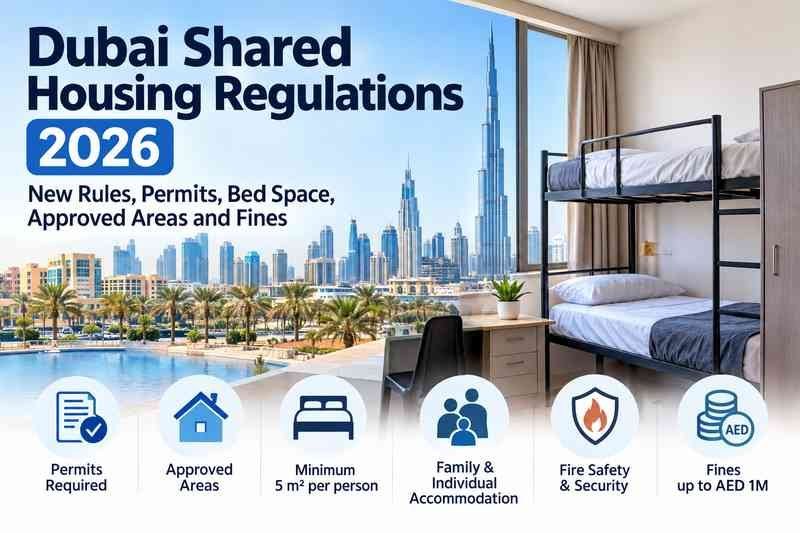
Dubai Shared Housing Regulations 2026: Dubai has introduced a new regulatory framework for shared housing, bringing clearer rules for properties used by multiple individuals or families.
Dubai Law No. 4 of 2026 on Regulating the Occupancy and Management of Shared Housing came into force on 8 September 2026. Dubai Municipality has now issued detailed planning and building requirements covering permitted areas, bedroom space, accommodation categories, facilities and other compliance standards.
The new rules are especially relevant to people living in shared apartments, bed spaces and other shared accommodation, as well as landlords, property managers and leasing companies.
Importantly, the new law does not mean that every form of flat sharing is automatically illegal. Instead, Dubai is creating a regulated framework for properties that are designated and operated as shared housing.
Dubai shared housing rules 2026
The new law aims to reduce overcrowding and informal housing while improving health, safety, privacy and the quality of residential buildings.
Dubai Municipality is responsible for overseeing shared housing and setting requirements related to:
-
permitted locations;
-
maximum occupancy;
-
space per resident;
-
shared facilities;
-
planning and building standards; and
-
technical and safety requirements.
The framework applies to relevant properties in Dubai, including private development zones and free zones.
Properties specifically designated as collective labour accommodation are excluded because they are regulated under separate legislation.
Shared housing permits in Dubai
A property cannot simply be designated for shared housing without the required permit.
Under Law No. 4 of 2026, the property must satisfy the applicable technical and regulatory requirements before a shared-housing permit can be issued. Dubai Municipality has also confirmed that permit applications and renewals are available through the Build in Dubai platform.
A shared-housing permit is generally valid for one year and can be renewed. The law also allows a two-year permit at the owner's request.
For renewal, the application must be submitted at least 30 days before the permit expires.
This makes the permit one of the most important things landlords and property operators need to check before offering a property for shared accommodation.
Dubai bed space and room-sharing rules
Bed-space accommodation is one of the areas most affected by the new regulatory framework.
The important point is that a person cannot simply rent a normal residential property and start selling individual beds or rooms to other residents as an informal business.
The 2026 law states that only the property owner or an authorised establishment may lease a shared-housing unit. Tenants and other unauthorised parties cannot sublease part of a shared-housing unit.
There are permitted legal structures where an authorised establishment manages a property for its owner or leases a property from the owner for the purpose of legally subleasing it to residents.
This means that the identity of the person collecting rent is important. A cheap bed-space advertisement does not, by itself, prove that the accommodation is authorised.
The 5 square metre bedroom requirement
One of the most important details in Dubai's new shared-housing requirements is the minimum bedroom space.
Dubai Municipality's Planning and Building Requirements Guide sets a minimum bedroom area of 5 square metres per person.
The rule is particularly relevant to crowded rooms where several beds are placed into a limited area.
However, the 5-square-metre figure should not be interpreted as a standalone permission to place any number of people in a room. The property must also comply with its approved accommodation category, occupancy requirements and other technical, health and safety standards.
For residents, this means that an extremely crowded room should not be assumed to be compliant simply because the landlord claims that the property has a shared-housing permit.
Family and individual shared accommodation
Dubai's new guide separates shared housing into different categories.
For existing buildings, the Municipality requires the building to be allocated to one category of shared housing — either individual accommodation or family accommodation.
Family accommodation has an additional privacy requirement.
Each family must have a separate bedroom with an en-suite bathroom.
The distinction is important because shared accommodation is not treated as one single category. The applicable requirements depend on the approved use and type of residents.
Approved areas for shared housing in Dubai
Location is another major part of the 2026 regulations.
Dubai Municipality has identified more than 44 approved areas where buildings may be used for shared housing. The Municipality has named areas including:
-
Al Souq Al Kabeer
-
Al Ras
-
Al Warqa 1
-
Al Barsha 1
-
Al Muraqqabat
-
Al Rigga
The list can be expanded as additional areas receive approval.
This means that the location of a property is an important part of determining whether shared accommodation can be legally operated there.
Residents looking for a bed space or shared room should therefore check more than the rent and location. The property's permitted use also matters.
Building and facility requirements
The new framework covers much more than bedroom size.
Dubai Municipality's guide sets requirements for shared facilities and services according to the accommodation category and number of residents.
These include:
-
kitchens;
-
sanitary facilities;
-
dining areas;
-
recreation areas;
-
laundry facilities; and
-
clothes-drying areas.
The requirements must also comply with relevant public-health and safety standards and the Dubai Building Code.
For new buildings and existing buildings that are modified for shared-housing use, the applicable planning, building and technical requirements must be met.
Fire safety and security requirements
Shared-housing approval is also connected to requirements from other authorities.
Dubai Municipality has confirmed that permit issuance requires the relevant prior approvals, including compliance with Dubai Civil Defence requirements for fire alarm and firefighting systems.
The Municipality also states that Security Industry Regulatory Agency (SIRA) requirements for CCTV systems are verified before a shared-housing permit is issued.
This makes fire protection and security an important part of the approval process rather than an optional feature for operators.
Shared housing tenancy and registration
The new law creates an electronic Shared Housing Register, with Dubai Land Department responsible for managing the register and its data.
The framework also provides for information relating to landlords, residents, units, allocated spaces and relevant lease or management contracts.
Dubai Land Department is also connected to the Municipality's shared-housing system, allowing tenancy-contract registration for buildings and villas designated for shared housing to be linked with permit information.
This represents a significant move away from informal arrangements where residents may only have a verbal agreement with the person collecting rent.
Shared housing advertisements
The 2026 law also regulates the promotion and advertising of shared-housing units.
Because shared housing now operates through a formal permit system, residents should be cautious with advertisements that provide only a phone number, rent amount and bed-space details without identifying the authorised party or relevant accommodation information.
For operators, compliance is not limited to the physical property. The way the accommodation is offered and managed also falls within the new regulatory framework.
Existing shared accommodation gets a compliance period
The new rules do not immediately require every existing shared-housing property to be shut down.
Owners and property-management or leasing companies that were already operating shared housing before the law took effect have been given one year from 8 September 2026 to regularise their properties and operations.
This gives the current regularisation period a target date of approximately 8 September 2027.
The law also allows the Director General of Dubai Municipality to grant a one-time extension where required.
However, the regularisation period is not a blanket exemption from enforcement.
Dubai Municipality has specifically stated that building violations, unauthorised changes of use and conditions that pose public-safety risks must still be addressed.
Dubai shared housing fines
The penalties under Law No. 4 of 2026 can be substantial.
Violations may attract fines ranging from:
AED 500 to AED 500,000.
If a violation is repeated within one year, the fine can be doubled, subject to a maximum of:
AED 1 million.
The maximum figure does not mean that every shared-housing violation automatically results in a AED 500,000 or AED 1 million fine. The applicable penalty depends on the specific violation and the relevant implementing decisions.
Authorities can also impose additional measures, including suspension of an activity for up to six months, cancellation of a shared-housing permit, action affecting a commercial licence, disconnection of public services until a violation is corrected and eviction measures for units that do not meet permit requirements.
Dubai Municipality inspections and overcrowding
Enforcement is already an active issue in Dubai's residential areas.
Dubai Municipality said its field teams conducted more than 16,000 inspection visits across residential areas during the first part of 2026 and recorded 2,395 violations.
Among the prominent violations were bachelor accommodation in areas where it was not permitted, multiple families occupying one residential unit and construction or alterations carried out without the required permits.
The figures show why the new shared-housing framework matters beyond paperwork.
Dubai's approach is focused on reducing overcrowding, controlling unauthorised residential use and ensuring that buildings are used according to approved requirements.
What the new rules mean for tenants
For people searching for affordable accommodation in Dubai, the new rules make it important to look beyond the advertised monthly rent.
Before paying for a bed space or shared room, residents should check:
-
whether the property is approved for shared housing;
-
whether the location is within an approved area;
-
whether the accommodation category matches the residents;
-
who is legally providing the accommodation;
-
whether the arrangement has the appropriate tenancy documentation;
-
whether the property appears seriously overcrowded; and
-
whether the advertised accommodation is being offered through an authorised operator.
A tenant should be particularly cautious if an existing tenant is collecting money from several people and informally allocating beds without an authorised shared-housing arrangement.
What the new rules mean for landlords
Landlords with properties being used as shared accommodation should review the property against the new requirements rather than waiting until the end of the regularisation period.
The key areas include:
-
permitted location;
-
approved accommodation category;
-
occupancy;
-
bedroom space;
-
shared facilities;
-
building-use approvals;
-
fire and safety requirements;
-
CCTV and security requirements where applicable;
-
permit requirements; and
-
tenancy and registration arrangements.
Dubai Municipality's latest guide is intended specifically to help owners and property-management companies assess their existing buildings and take corrective action.
Shared housing is not the same as collective labour accommodation
Another important distinction is between shared housing regulated under Law No. 4 of 2026 and collective labour accommodation.
The new shared-housing law expressly excludes properties designated for collective labour accommodation because those properties are governed by separate legislation.
This distinction is important when interpreting online reports about Dubai accommodation rules. A rule applying to shared residential housing should not automatically be presented as applying to every form of worker accommodation.
The practical impact on Dubai residents
Dubai's 2026 shared-housing framework is essentially moving the market away from informal bed-space and overcrowded accommodation toward a system based on approved locations, permits, defined occupancy, minimum space, proper facilities and accountable operators.
For tenants, the biggest change is the need to be more careful about who is offering accommodation and whether the property is authorised.
For landlords and property managers, the focus is now on bringing buildings into compliance with the Municipality's planning, building, safety and occupancy requirements.
The most important dates are also clear: the law became effective on 8 September 2026, while existing shared-housing properties have a one-year regularisation period, subject to the possibility of a one-time extension.
Dubai shared housing regulations 2026 Table
| Rule | 2026 requirement |
|---|---|
| Law | Dubai Law No. 4 of 2026 |
| Effective date | 8 September 2026 |
| Permit | Required for designated shared housing |
| Standard permit validity | 1 year |
| Two-year permit | Available at owner's request |
| Bedroom space | Minimum 5 sq m per person |
| Building category | Individual or family accommodation |
| Family accommodation | Separate bedroom and en-suite bathroom for each family |
| Approved locations | More than 44 areas identified so far |
| Existing-property regularisation | 1 year from 8 September 2026 |
| General fine range | AED 500–AED 500,000 |
| Repeat violation | Up to AED 1 million |
| Collective labour accommodation | Governed separately |
Dubai's shared housing regulations in 2026 are not simply a ban on people sharing accommodation.
They establish a formal system for where shared housing can operate, how much space residents must have, what facilities are required, who can legally provide the accommodation and how properties are monitored.
For anyone searching for a bed space, shared room or shared apartment in Dubai, the safest approach is to verify the property and operator rather than relying only on a low rental price.
For landlords and property managers, the priority is to review the property's approved use and bring it into line with Dubai Municipality's latest requirements before the regularisation period ends.
Dubai Municipality's latest Planning and Building Requirements Guide was issued on 7 October 2026, making it the most current practical reference alongside Law No. 4 of 2026.
Official sources
-
Dubai Legislation Portal: Law No. 4 of 2026 and Dubai's official legislative database.
-
Dubai Official Gazette: Law publication, Issue 764, dated 12 March 2026.
-
Dubai Municipality: Building and Planning Circulars, including Circular 1-3-1 and the detailed shared-housing attachment.
-
Dubai Municipality / WAM: Planning and Building Requirements Guide issued 7 October 2026.
-
Dubai Land Department: Official property and tenancy regulatory resources.


0 comments
No comments yet. Be the first.