

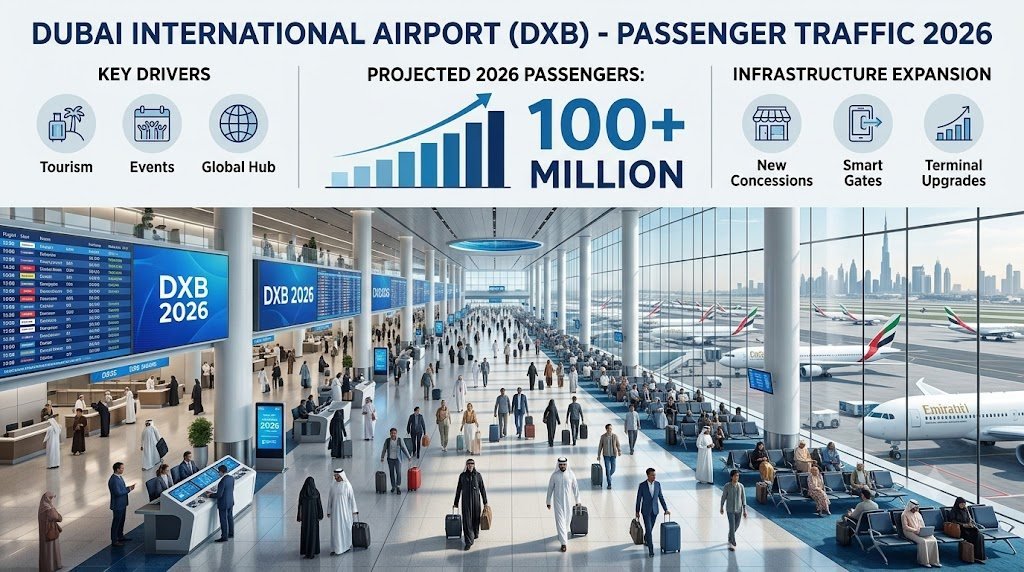
Dubai Airport Passenger Traffic 2026: Dubai International Airport was supposed to be heading towards another record year.
At the start of 2026, Dubai Airports expected DXB to handle close to 99.5 million passengers, after welcoming a record 95.2 million in 2025. That forecast now looks very different.
DXB handled 31.5 million passengers during the first half of 2026, a 31.3% drop from the roughly 46 million recorded in the first six months of 2025. Aircraft movements were down 32.1% as well, to around 150,600.
The decline came as the regional conflict disrupted airspace, forcing airlines to cancel, reroute and reschedule flights. Dubai was affected along with other airports across the region.
But the latest numbers are not all pointing down.
Traffic began picking up during the second quarter
The second quarter was the hardest part of the first half, with DXB handling about 13 million passengers from April to June.
There was, however, a noticeable difference between the beginning and end of the quarter.
Dubai Airports recorded about 3.5 million passengers in April, 4.5 million in May and 5 million in June. In other words, passenger traffic was already moving upwards before the summer travel period began.
That matters at an airport like DXB, where a large proportion of travellers are flying internationally or connecting through Dubai rather than ending their journey in the emirate.
By July, monthly passenger traffic had reached around 6.3 million.
The summer recovery was also visible at Emirates. The airline said it operated at about 93% of its pre-disruption capacity during July and August, carrying more than 8.6 million passengers over the two months. It has also reported stronger bookings for some routes during the winter season.
Emirates said another change has been noticeable in the way people book flights. Some travellers are leaving their reservations until closer to departure, making advance booking figures less straightforward as a measure of future demand.
The 2026 forecast has been cut
For Dubai Airports, the recovery has come too late to preserve the forecast made at the beginning of the year.
The airport now expects to handle around 70 million passengers in 2026, according to CEO Paul Griffiths. The previous target of nearly 100 million has effectively moved into the following year, with Griffiths saying that level is now likely to be reached in 2027.
The gap is considerable.
DXB handled 95.2 million passengers in 2025, its busiest year on record. The airport operator had expected another increase in 2026, with traffic forecast at about 99.5 million before the regional disruption changed the outlook.
A 70-million total would therefore leave DXB well below last year's record.
Still, the airport is not seeing the same conditions it faced during the spring. Airlines are bringing back services and passenger volumes have been improving.
Airlines are returning at different speeds
The recovery has not been identical across the industry.
Flydubai said on September 16 that it was operating at about 85% of its network capacity and expected to return to full operational capacity by the end of 2026. The airline also expects its fleet to grow beyond 100 aircraft after new Boeing deliveries.
Emirates is also adding services. A new Helsinki route is planned for October, while capacity is being increased on selected routes including Accra and Hanoi.
Some international airlines remain more cautious about restoring their full schedules, so the speed of the recovery will depend partly on how quickly those services return.
For passengers, the difference is noticeable. A restored flight is not just another option on a departure board. At DXB, it can also reopen connections between cities across Europe, Asia, Africa and the Middle East.
DXB's international role remains intact
The fall in passenger numbers has not changed what makes Dubai's airport important to the global aviation network.
DXB remains focused heavily on international traffic, with a large connecting passenger base. Dubai Airports says the airport's network links travellers with hundreds of destinations through international carriers.
That network also explains why the airport has been able to recover relatively quickly once airline capacity began returning.
The first-half figures were weak, but Dubai Airports said passenger volumes were strengthening through the second quarter as connectivity improved and load factors recovered.
The summer travel period provided another test. Emirates' July and August numbers suggest that passengers were willing to travel once capacity became available, even though booking patterns remained less predictable than usual.
Dubai Airport Passenger Traffic 2026: Dubai's second airport plan is still moving ahead
The short-term decline at DXB has not changed Dubai's longer-term aviation plans.
Work continues on Al Maktoum International Airport (DWC), which is being developed to handle much larger passenger volumes in the future.
Dubai Airports says the project is designed to accommodate 150 million passengers a year within the next decade, eventually reaching 260 million passengers. The planned expansion carries an investment of around US$35 billion.
For now, DXB remains Dubai's main international gateway. DWC is the longer-term answer to the emirate's need for additional aviation capacity.
What the latest numbers tell us
The 2026 passenger figures have changed considerably since the start of the year.
The original expectation was close to 100 million passengers. The first six months instead produced 31.5 million, with the sharpest disruption occurring during the spring. Since then, monthly traffic has improved, airline capacity has started coming back and demand has shown signs of recovery.
Dubai Airports is now working with a much lower full-year estimate of about 70 million passengers.
The remaining months will show how much of the lost traffic can be recovered. Emirates is reporting stronger winter bookings on some routes, while flydubai expects to return to full capacity before the end of the year.
For DXB, 2026 is no longer about setting another passenger record. The immediate job is getting the airport's international network back to full strength and carrying that recovery into 2027.



0 comments
No comments yet. Be the first.