
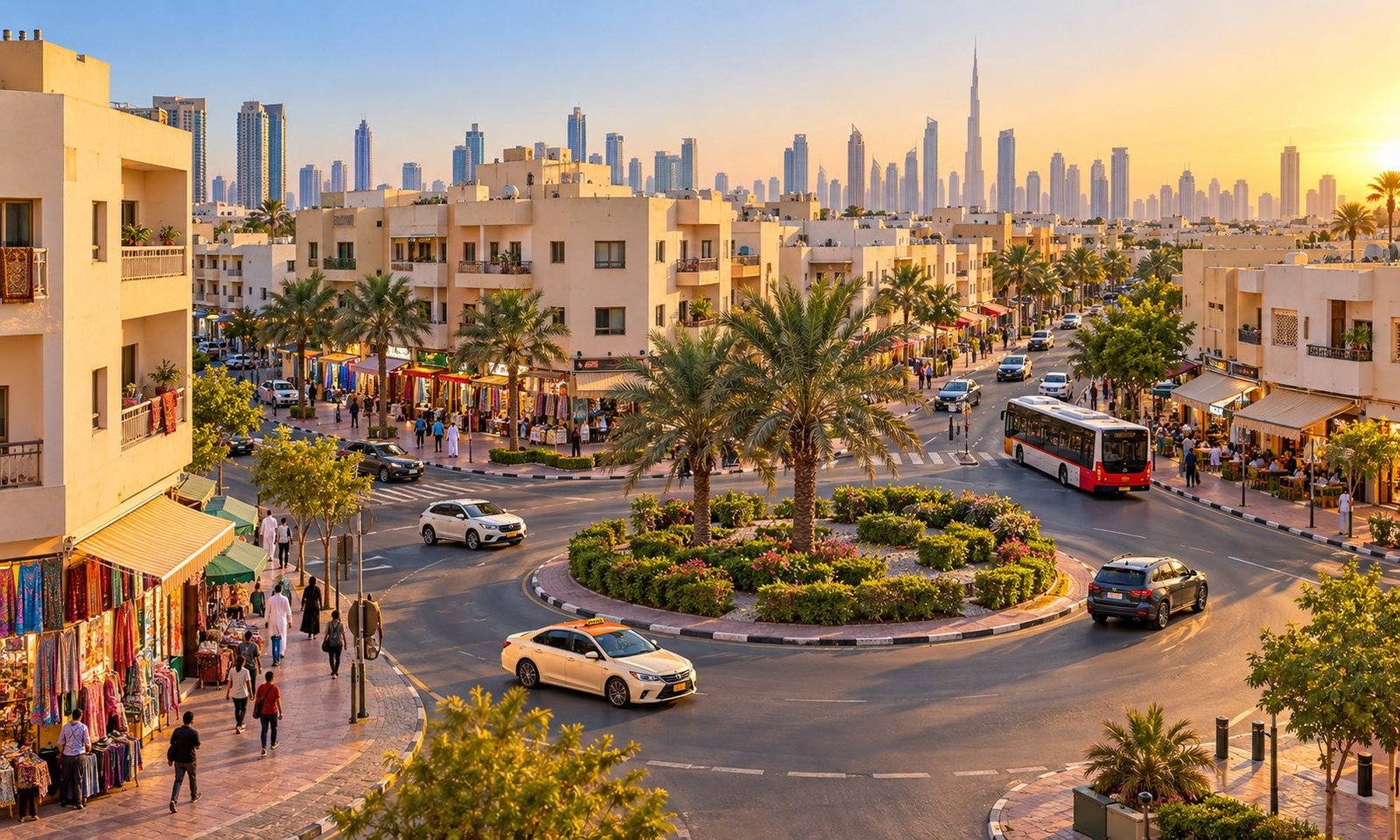
Satwa Roundabout is a familiar reference point in Dubai’s Al Satwa neighbourhood, an area known for textile shops, casual restaurants, small businesses and a diverse residential community. For visitors, it provides a useful starting point for exploring the streets around Al Satwa Road and 2nd December Street. For residents, the name is part of everyday directions, shopping trips and journeys across the city.
Its surroundings tell a story that extends beyond transport. Long-established food businesses, tailoring shops and public artworks reflect different stages of Dubai’s growth. At the same time, planned road improvements show how the neighbourhood continues to change.
An important development: Dubai’s Roads and Transport Authority has announced plans to convert Al Satwa Roundabout into a signal-controlled junction as part of the Al Wasl Road Development Project. The official announcement reviewed confirms the planned conversion, but does not establish that it has been completed.
Information researched on 11 October 2026. Transport arrangements, road access and individual business hours may change.
Where Is Satwa Roundabout?
Satwa Roundabout is associated with the northern part of Al Satwa and the 2nd December Street corridor, close to the neighbourhoods of Al Hudaiba, Al Bada’a and Al Jafiliya. The surrounding road network connects this part of Dubai with Jumeirah, Bur Dubai and the World Trade Centre area.
Dubai’s official tourism website explains that motorists can reach northern Al Satwa from Sheikh Zayed Road through 2nd December Street. This is a more useful description than treating Sheikh Zayed Road itself as part of the local roundabout.
A recognisable nearby landmark is Chelsea Plaza Hotel, whose official website gives its address in Satwa. Local directories place it at Satwa Roundabout on 2nd December Street. Sharing the hotel’s map pin or the exact destination helps avoid confusion when arranging a taxi or meeting someone.
| Detail | Information |
|---|---|
| City | Dubai, United Arab Emirates |
| Neighbourhood | Al Satwa |
| Main street reference | 2nd December Street |
| Older street name | Al Diyafah or Al Dhiyafah Street |
| Nearby hotel landmark | Chelsea Plaza Hotel |
| Nearby Metro options | Max and World Trade Centre stations |
| Main visitor interests | Dining, textiles, tailoring, street art and neighbourhood life |
The table combines location, historical naming and transport information from the sources cited throughout this article.
Satwa Roundabout and Trade Centre Roundabout Are Different Places
The two names can cause confusion because they are connected by the wider 2nd December Street corridor.
Satwa Roundabout is the local landmark associated with Satwa’s shops and residential streets. Trade Centre Roundabout is the separate junction associated with Sheikh Zayed Road and the Dubai World Trade Centre area.
RTA’s Trade Centre development announcements describe traffic movements from 2nd December Street, serving Jumeirah and Al Satwa, towards other central Dubai roads. Its Al Wasl Road announcement separately identifies the planned conversion of Al Satwa Roundabout. These are distinct locations within the broader road network.
The History of the Surrounding Neighbourhood
Satwa’s significance comes largely from the people and businesses that have occupied its streets over several decades.
A historical feature published by AramcoWorld in 2015 described how Dubai’s infrastructure expansion from the 1960s included housing in Satwa for Emirati citizens. The neighbourhood later became home to a substantial expatriate population, with older homes and commercial streets taking on new uses as Dubai expanded.
Khaleej Times has documented the area’s earlier association with Baluchi and Iranian communities, followed by a growing population of Indian, Pakistani, Bangladeshi, Filipino and Arab residents. That mix is reflected in the neighbourhood’s food, shops and everyday services.
The sources reviewed did not establish a reliable original construction date for the roundabout itself. Its history is therefore best discussed through documented changes to Satwa and its streets, rather than an unverified opening year.
Why Al Diyafah Street Became 2nd December Street
The road’s older name remains familiar to many residents and still appears in business addresses.
In 2011, Al Diyafah Street was renamed 2nd December Street to mark the UAE’s 40th National Day. Contemporary reporting explained its historical relevance: the street leads towards Dar Al Ittihad, or Union House, associated with the declaration of the UAE on 2 December 1971.
For visitors, this explains why one person may give directions using “Diyafah” while a map or road sign uses “2nd December Street.” Both names can refer to the same street.
A Neighbourhood Shaped by Small Businesses
The streets around Satwa Roundabout contain a concentration of practical, everyday businesses. Reporting on Al Satwa identifies tailors, garment stores, supermarkets, electronics shops, mobile-phone retailers, cafés and restaurants along Al Satwa Road and 2nd December Street.
This makes the area useful for visitors with a specific errand as well as those who want to explore. Shopping here often involves visiting several individual stores, comparing materials and speaking directly with the people providing a service.
The street itself forms part of the experience: residential buildings, small shopfronts and dining establishments sit close together, giving the neighbourhood a busy, lived-in character.
Textile Shopping and Tailoring
Fabric shopping is one of Satwa’s best-known attractions. Dubai’s official tourism website highlights Deepak’s Textiles among the area’s established fabric businesses and identifies textiles as an important part of Satwa’s identity.
For anyone ordering a garment, the useful questions are practical: what does the price include, who supplies the fabric, how many fittings are offered and when will the finished item be ready?
A photograph or sample can help explain the desired design. Visitors on short trips should agree on the collection date before paying, especially when alterations or more than one fitting may be necessary.
Food Around Satwa Roundabout
Food is a major reason to spend time in the surrounding neighbourhood. Dubai’s official tourism material highlights several established restaurants and a choice of South Asian and Arabic food.
Ravi Restaurant
Ravi is closely associated with Satwa’s dining history. Visit Dubai recommends it for Pakistani food, while AramcoWorld’s historical reporting traces the restaurant’s operation to 1976. Its long presence helps explain why it appears so often in accounts of the neighbourhood.
Al Mallah
Al Mallah is another established name associated with Satwa. Visit Dubai describes its Lebanese food, including shawarma, falafel and grilled dishes, and dates its opening in Satwa to 1979. Check the current branch location and opening hours before making a dedicated trip.
Other Choices
Visit Dubai’s neighbourhood guide also lists Miamix for Sri Lankan food and Al Baik for Saudi-style fried chicken along 2nd December Street. Its arts and culture guide mentions Nujood Sweets for Pakistani desserts. These options illustrate the range of food available across the area.
Restaurant prices vary, so menus are a better guide to a visit’s cost than older online meal-price estimates.
Street Art and the Dubai Street Museum Project
The buildings along 2nd December Street became part of a major public-art initiative in 2016.
Contemporary reporting describes 16 murals created by 16 artists, with imagery connected to the UAE’s history and heritage. The project brought large artworks into an existing commercial and residential street, making art part of an ordinary neighbourhood walk.
Dubai’s Government Media Office confirms that the wider Dubai Street Museum initiative began in 2016 to express the city’s identity through public artworks.
The murals are an important part of the street’s recent history. However, historical photographs should not be treated as confirmation that every original artwork remains visible or unchanged today.
How to Reach Satwa Roundabout by Metro
There is no Metro station directly at Satwa Roundabout. Max Metro Station and World Trade Centre Metro Station are nearby Red Line options.
Moovit’s location page places both within roughly 1.4 to 1.6 kilometres of its selected Satwa Roundabout map point. Exact walking distances depend on the station exit, destination and available crossings, so travellers should check the route rather than rely on a single walking-time estimate.
For someone carrying shopping bags or travelling in hot weather, a connecting bus or taxi may be more comfortable than walking the final section.
Bus Connections and Nearby Stops
Bus services are especially useful in Satwa. Visit Dubai identifies the neighbourhood as having a major bus station with connections across the city.
Transport listings show several nearby stop names, including:
-
Satwa, Roundabout.
-
Hana Center.
-
Satwa, Mosque.
-
Satwa Post Office.
These are separate stops, and the correct one depends on the direction of travel. Al Satwa Bus Station is also a distinct destination, so it should not automatically be used as a substitute for the roundabout when planning a journey.
Official RTA timetable material identifies Satwa, Roundabout on routes including F28 and 98E. RTA has also announced changes to services around the area, including an F12 route revision in 2025. Check the current RTA journey planner for the route, stop and departure time on the day of travel.
Road Improvements Affecting the Area
Two official transport developments are relevant to readers researching Satwa.
First, the Al Wasl Road Development Project includes the planned conversion of Al Satwa Roundabout into a signal-controlled intersection. The broader scheme covers 15 kilometres of Al Wasl Road and several junction upgrades. The announcement establishes the project’s scope, rather than the current completion status of the Satwa junction.
Second, RTA’s dedicated bus and taxi lane expansion includes Al Satwa Street, 2nd December Street and Sheikh Sabah Al Ahmad Al Jaber Al Sabah Street. An official progress update reported that the wider project had reached 30% completion at the time of that announcement. Its purpose includes improving bus journey times and service reliability.
These changes make up-to-date navigation particularly useful. Older street photographs and fixed driving instructions may not reflect the arrangements encountered during a visit.
Places to Combine With a Satwa Visit
Several cultural destinations can be included in a broader outing. They are separate places, rather than attractions located directly on the roundabout.
| Place | Main interest |
|---|---|
| 2nd December Street | Restaurants, shops and the history of its street-art project |
| Etihad Museum | Exhibitions about the formation and development of the UAE |
| Union House | A landmark connected with the country’s founding |
| Jumeirah Mosque | Architecture and organised cultural visits |
| Al Khazzan Park and City Walk | Additional stops on a longer urban walk |
Visit Dubai highlights Etihad Museum’s interactive exhibitions and Jumeirah Mosque’s guided visits for people of different faiths. Its urban-art walking guide also connects destinations including Al Khazzan Park, City Walk, 2nd December Street, Etihad Museum and Union House.
Planning a Visit
A useful approach is to choose one main purpose: fabric shopping, a meal, photography or a walk along 2nd December Street. This helps determine the best arrival point and how much walking to include.
For a short outing, start near a clearly identified landmark, explore the surrounding shops and finish with a meal. A longer visit can include Etihad Museum or another cultural stop, with transport between destinations where needed.
Allow time for parking if driving. Local guides identify paid roadside parking around the commercial streets, but spaces can be harder to find during busy periods. Check the signs at the actual parking bay for its applicable conditions.
Use designated pedestrian crossings, keep entrances clear when taking photographs and ask before photographing people closely or entering a shop to take pictures.
Why Satwa Matters to Dubai’s Story
Satwa’s importance is visible in the continuity of its everyday businesses and the communities that use them. Historical reporting records both its changing housing and the personal attachment residents have to its streets. Food, tailoring, shopping and neighbourhood relationships all form part of that history.
For a visitor, Satwa Roundabout provides a starting point for discovering those details. The most rewarding visit is one that leaves time to browse a fabric store, speak with a tailor, try a restaurant and explore the streets that have made the name familiar to generations of Dubai residents.

0 comments
No comments yet. Be the first.